
My Reflections by Dr. Mike Ghouse
Welcome to My Reflections, a personal journal by Dr. Mike Ghouse — founder of InterfaithMarriages.org and lifelong advocate for pluralism, harmony, and understanding among all faiths.
Through these reflections, Dr. Ghouse shares moments from the weddings he officiates, his thoughts on love that transcends religion, and experiences that celebrate the beauty of our shared humanity. Each note captures a story — a smile, a prayer, a union — that reminds us that love is universal and faith is deeply personal.
Over the years, Dr. Ghouse has had the honor of uniting hundreds of interfaith and intercultural couples from around the world. His reflections here are more than words — they are glimpses into real lives where compassion triumphs over difference, and where two traditions meet in mutual respect.
In a world often divided by belief, My Reflections stands as a gentle reminder that pluralism is not about converting others, but about understanding them. Each post is a window into how faiths can come together — not in conflict, but in celebration of the divine diversity within us all.
When Love Calls, I Show Up, No Matter What — The Owings Mills Tale
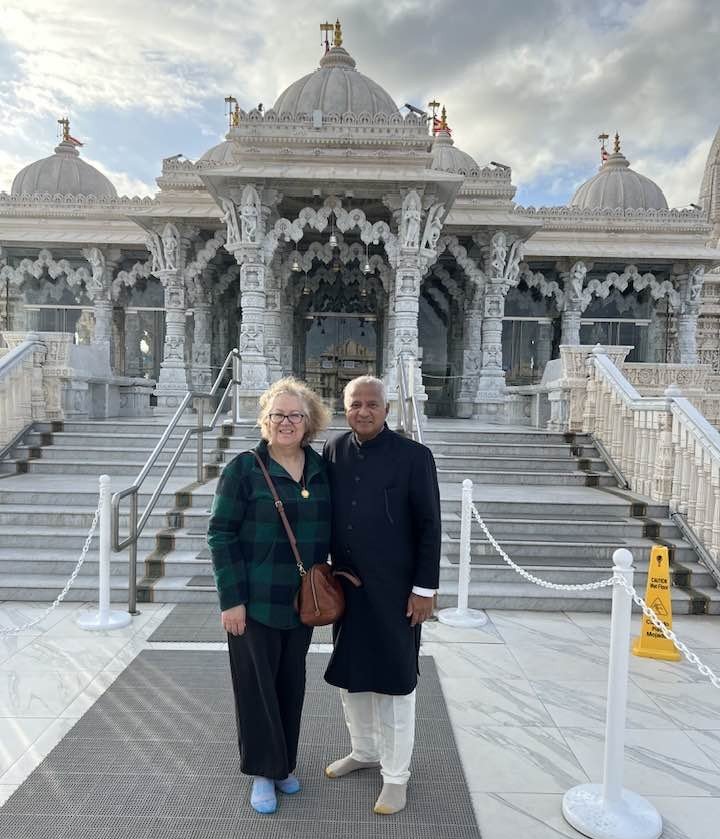
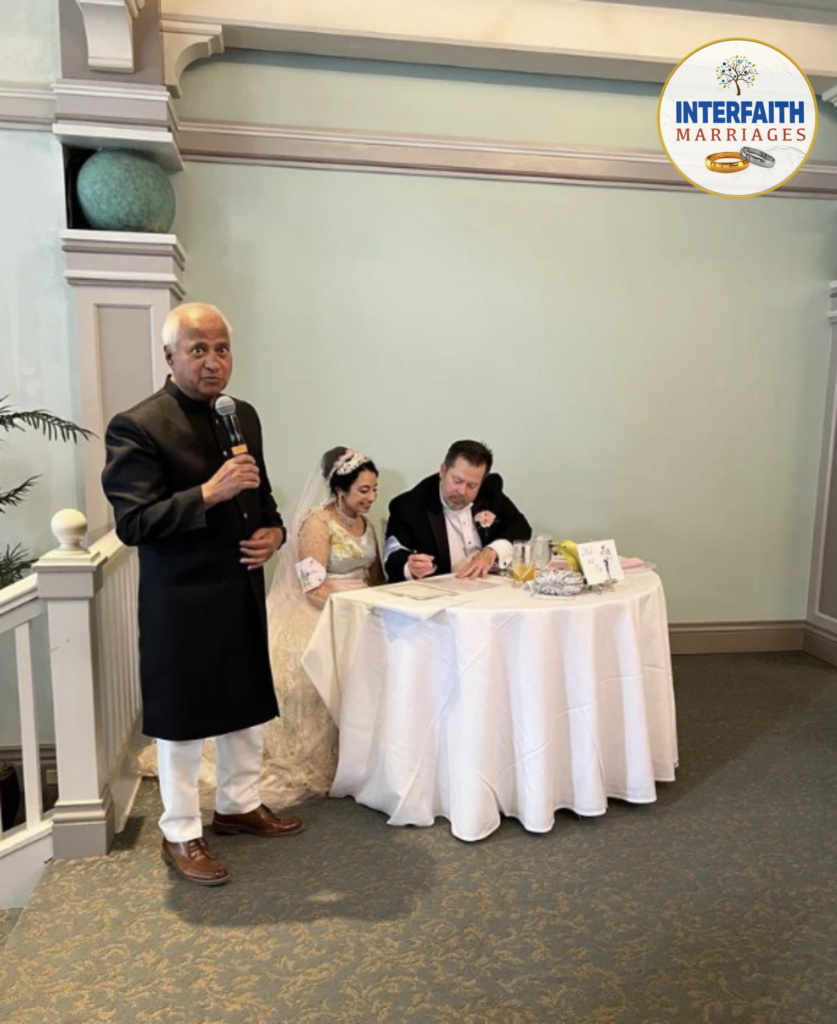
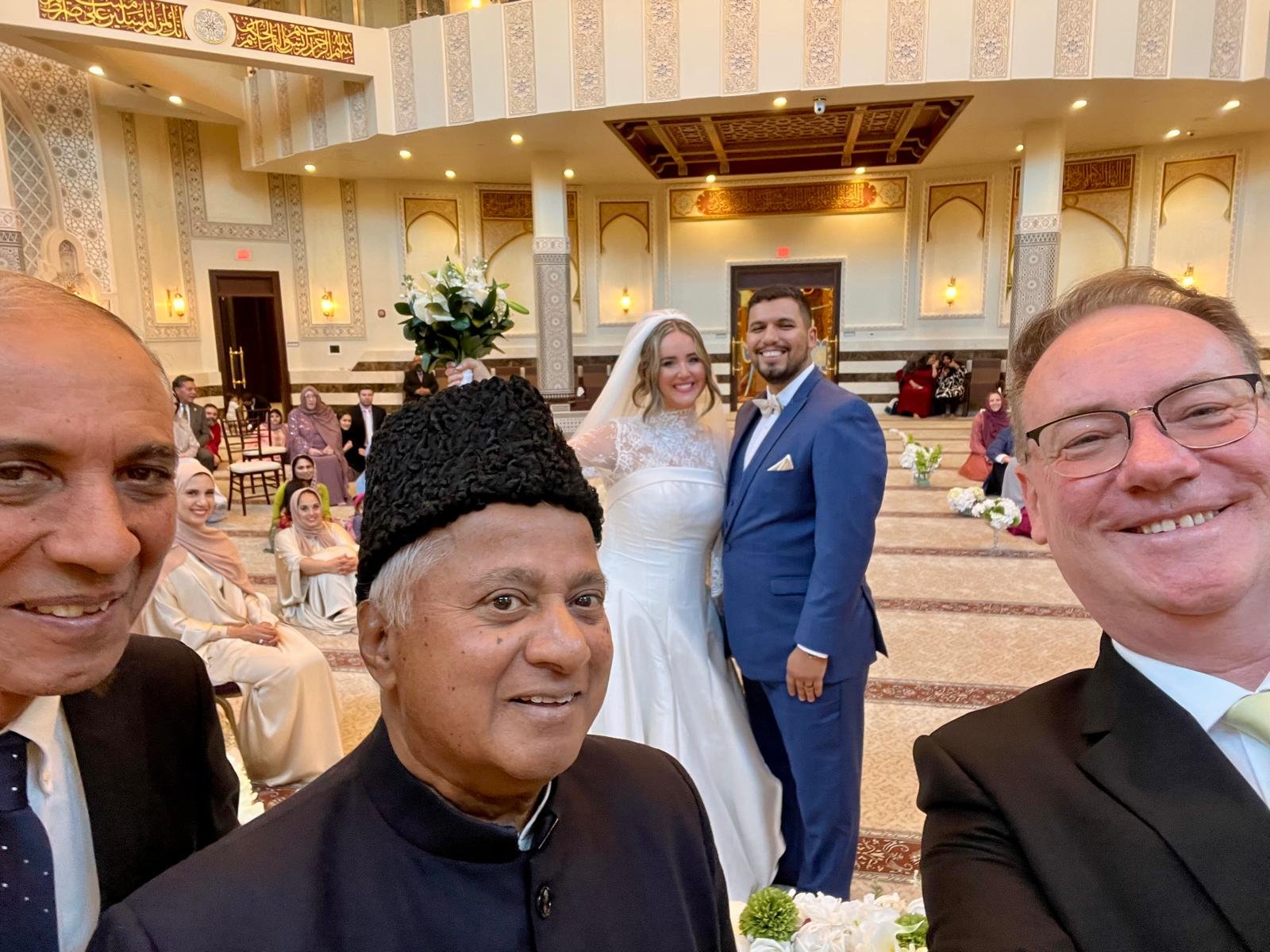
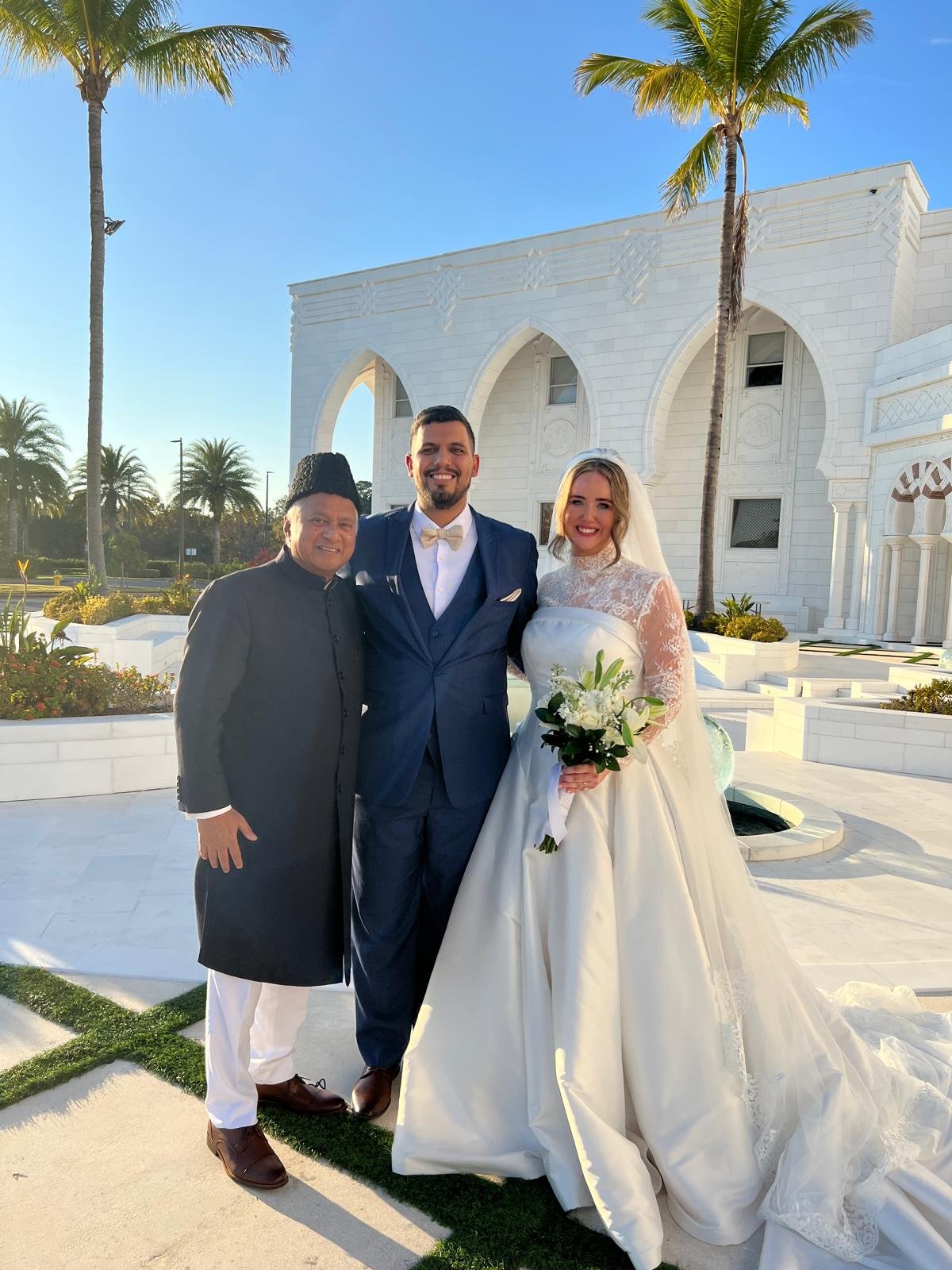
Today, I had the honor of officiating a beautiful Christian-Muslim wedding in Owings Mills. It was not just another ceremony — it felt like a continuation of a sacred journey.
Three years ago, I stood with this same family to officiate the bride’s sister’s wedding. And today, as I looked around the room, I saw many familiar faces — guests who had returned once again, not just to witness a marriage, but to celebrate love that transcends faith and tradition.
Moments like these remind me that interfaith weddings are not simply events. They are powerful statements — that love is bigger than labels, and unity is stronger than division.
I remain deeply grateful that I have never missed a single wedding, no matter the circumstances.
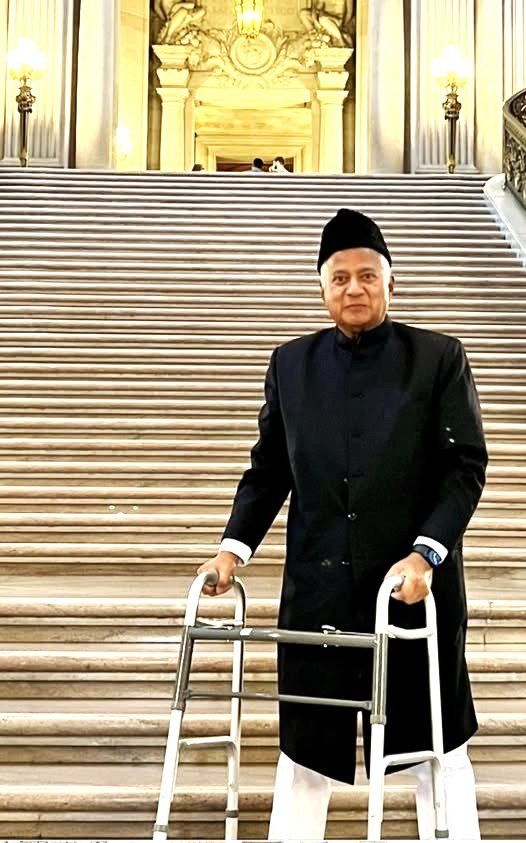
Last year, even after a fall that left me unable to walk for an entire week, my commitment did not waver. Using a walker, I climbed the steps of San Francisco City Hall to officiate a wedding in the Mayor’s Office. It was a meaningful joint ceremony — led together by a Catholic Father and myself — a beautiful symbol of cooperation, respect, and shared humanity.
I have officiated several weddings at City Hall in Boston as well, where even the Mayor joined in to offer blessings and joy to the couple.
To me, these ceremonies are more than vows and rings. They are bridges between communities. They are reminders that love is courageous, and that harmony is possible — one couple, one family, one wedding at a time.
And whenever love calls, I will continue to show up.
Mike Ghouse

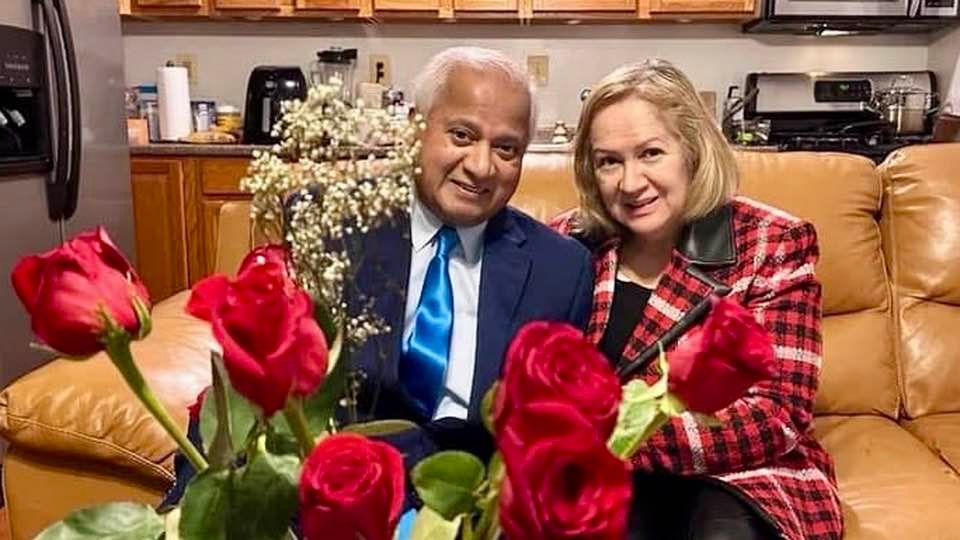
First Dinner Outing after my Surgery
Side by side tonight, first dinner out since the surgery. Feeling her presence close, sharing stories and smiles—it’s quiet, yet it feels like a victory. Recovery was hard, but moments like this make every step worth it.

597th Wedding | 200th Christian - Muslim Wedding
THANK YOU, FATIMA.
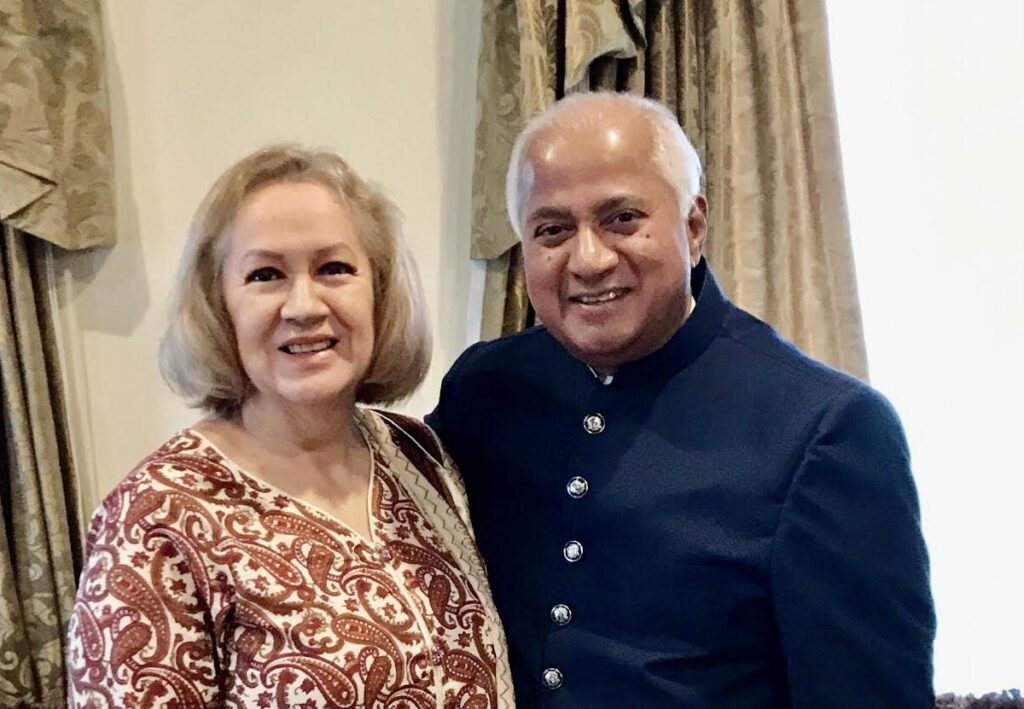
I am deeply grateful to God and to my family and friends for their prayers and well-wishes. I have recovered from my open-heart surgery, which took place on 7 January. Now, one month later, my health appears stable. Reflecting on this period, I realize I could not have made it through without Fatima, who provided unwavering care and support.
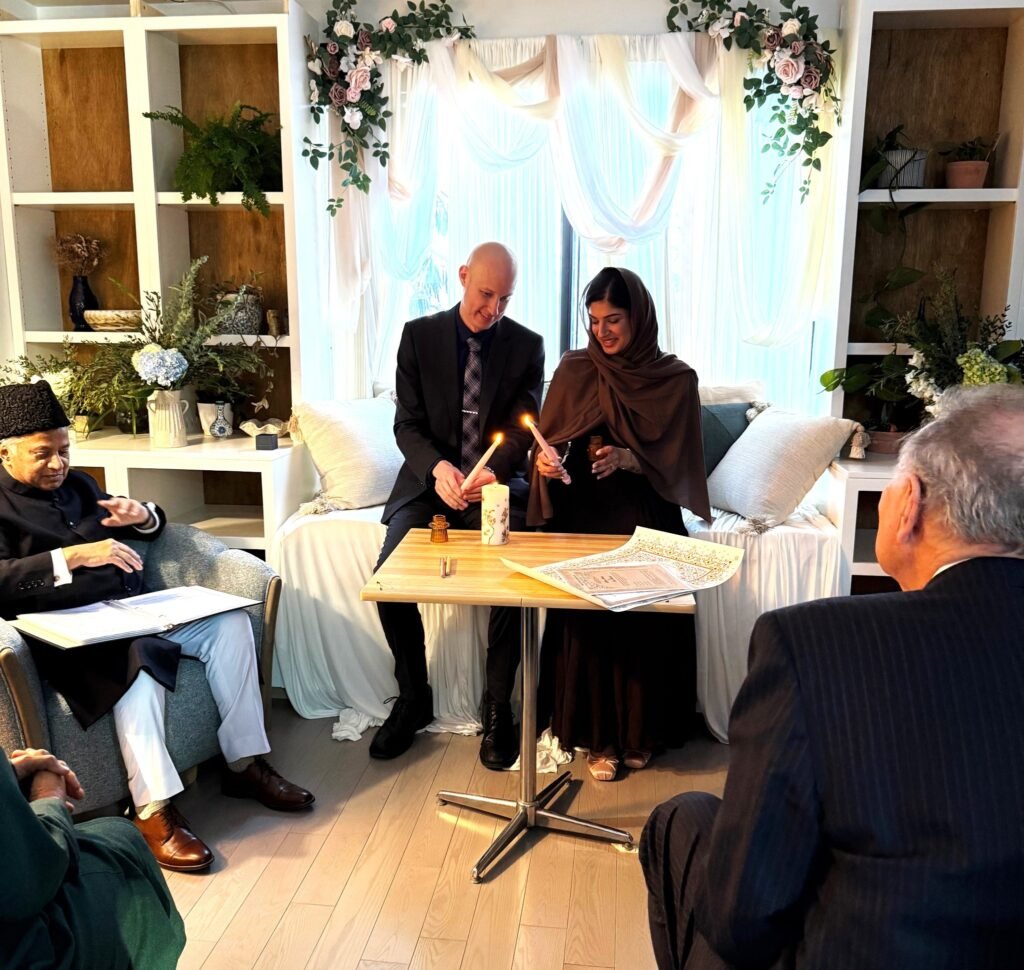
Today, I officiated a Christian-Muslim wedding in Owing Mills. Three years ago, I had also officiated at the bride’s sister’s wedding, and many of the guests were the same as before.
Farah, the older sister, shared with me that she had experienced breast cancer, and Owen supported her throughout her illness. We both observed that such challenges can strengthen the bond between partners.
This ceremony marked the 200th Christian-Muslim wedding of the 597 weddings I have officiated. It was also the ninth wedding within these interconnected families: three sisters in Odessa, two pairs of brothers and sisters in Ashburn, two cousins, and two sisters in Owing Mills today. Another wedding, involving two brothers, is scheduled in Iceland. The grandparents have assured me that additional family members, especially among the Afghan families in Michigan, may also seek my services.
Mike Ghouse
594th Wedding | BACK TO WORK
Today, I officiated the 594th Interfaith Wedding and the 199th Christian-Muslim wedding. Both of them are pilots, and this is the 4th pilot wedding. It is a joy to be a universalist, meaning almost every trade and profession and 95 ethnicities (countries). About 40% of our weddings are for doctors and Lawyers.
Fatima, my wife, makes the best tea on earth. I start my day with her chai (tea).
Mike Ghouse
Reversal of Greetings
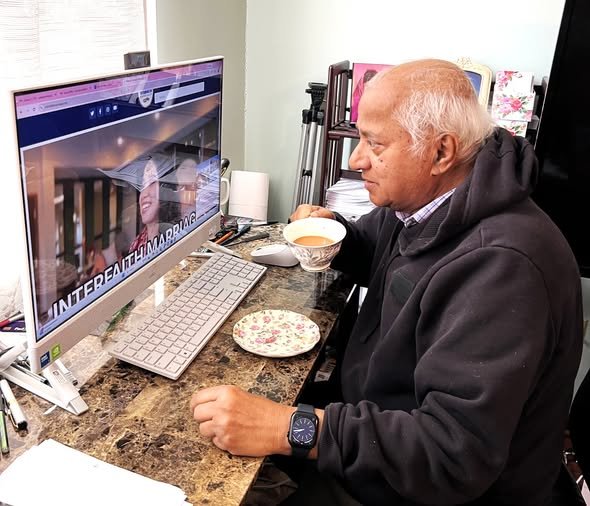
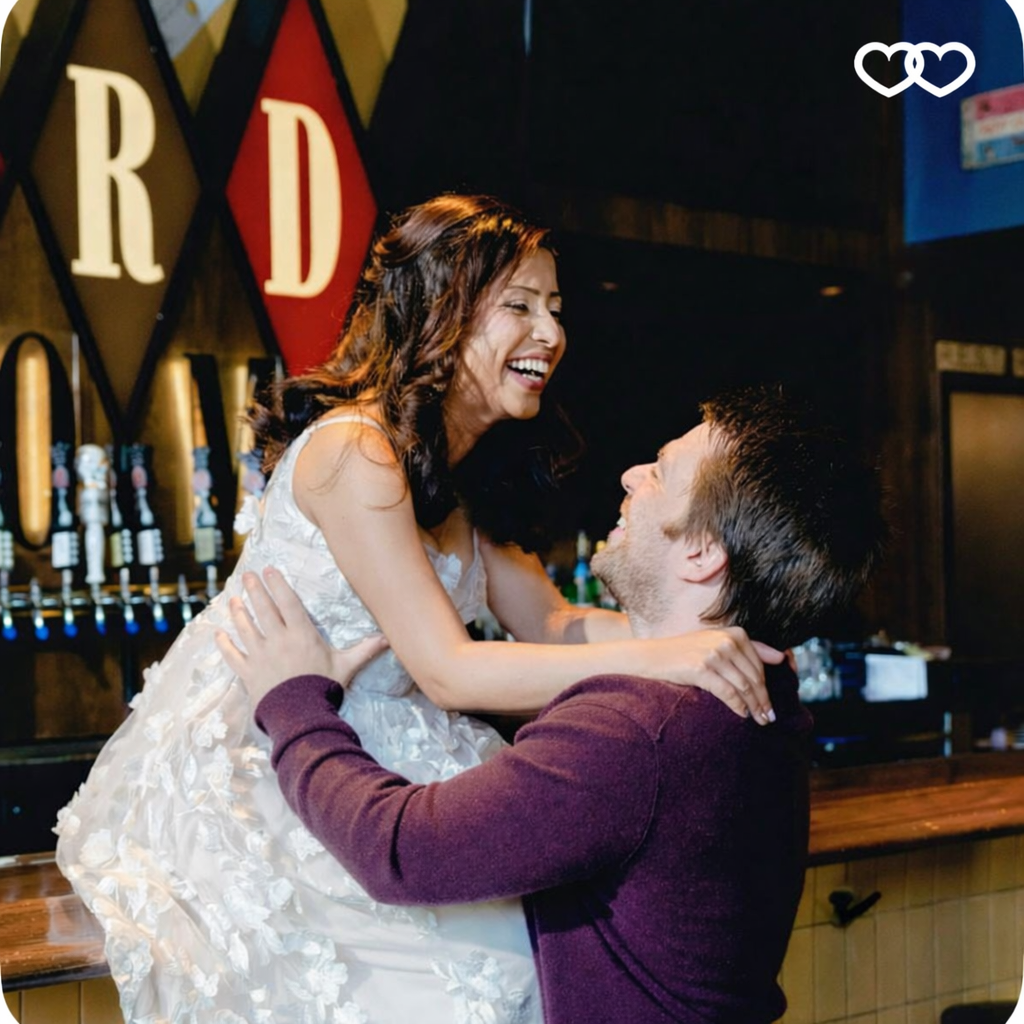
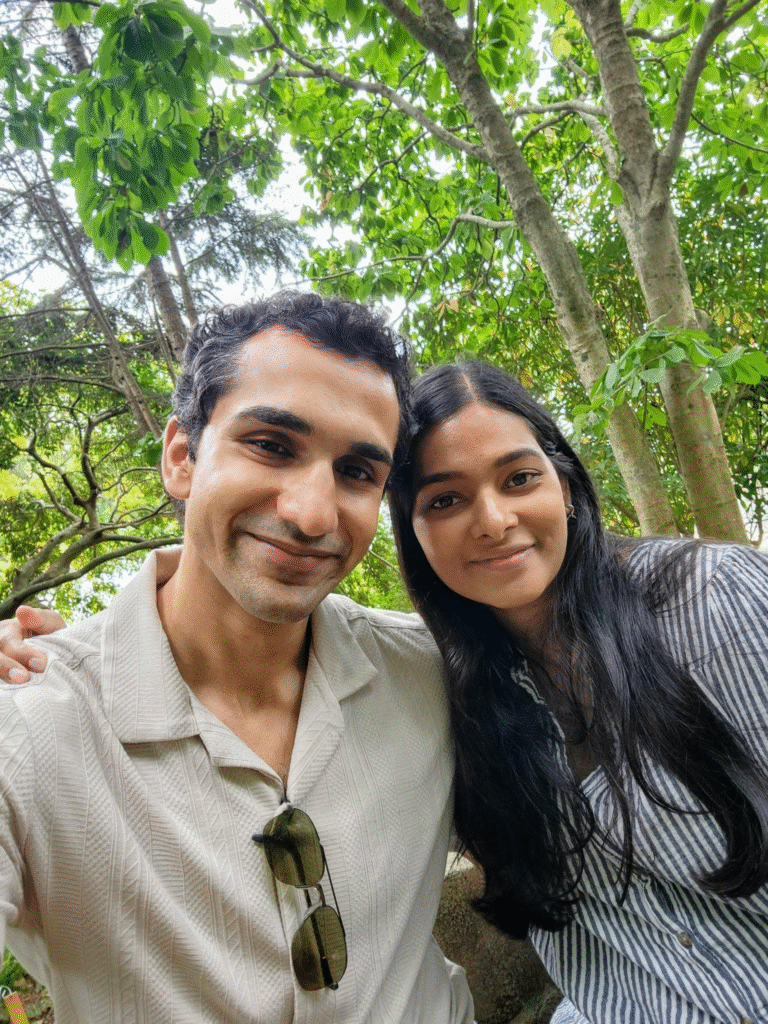
It brings me great joy to receive anniversary greetings from the couples I have officiated weddings for. I send them happy anniversary wishes, and now they are sharing pictures of their newborn babies and, in one case, their child’s high school graduation. I will be sharing a few samplers now and then.
“As we step into 2026 and count down to the big day (it’s hard to believe we’re about 100 days away!), we just wanted to share how grateful we are for all the care and heart you’ve already put into everything so far. We’re so happy to be working with you and are truly looking forward to the months ahead. Wishing you and your loved ones a bright, joyful, healthy, and successful year! “
Anika and Josiah
Happy Anniversary!
I hope you are enjoying a fulfilling life together. Your commitment to each other is a promise to live in harmony, tranquility, and peace. My commitment is to help mitigate conflicts and nurture goodwill. Please feel free to reach out to me anytime if you need someone to talk to. Attentive listening fosters trust, and sincere apologies can heal any disappointments. Each week offers a chance for renewal, especially after Sunday breakfast.
I would love for you to share a recent photograph of your family. Please know that I am always here to support you and engage in conversations that promote a harmonious life with minimal conflict.
Additionally, please take a look at these articles about me:
592nd Wedding | 62nd Muslim Nikah Maggiano's Italian Restaurant
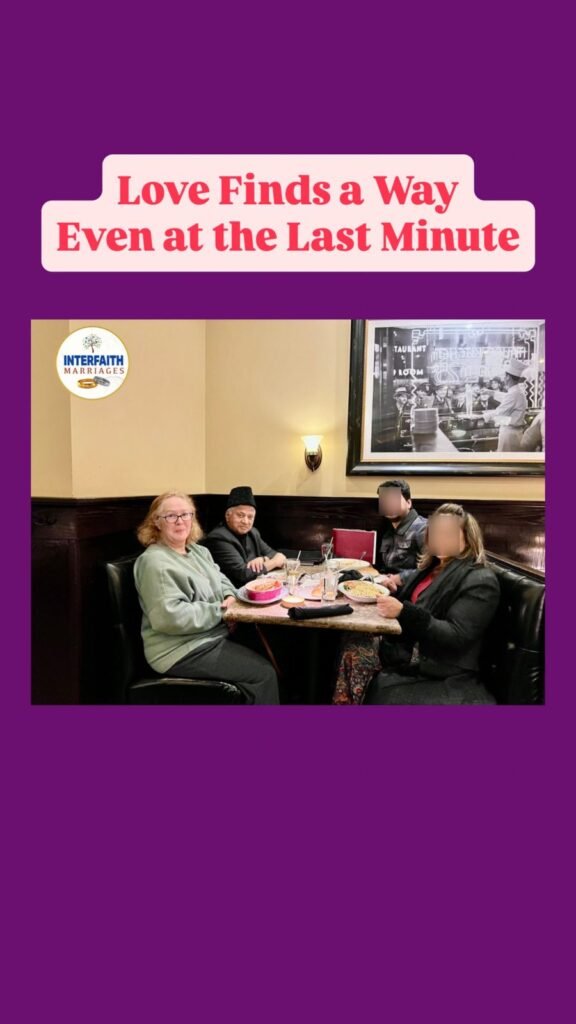
I closed the year with my 198th Christian-Muslim interfaith marriage. However, there is always the possibility of a last-minute wedding, and that occurred last night at Maggiano’s Italian restaurant in Virginia. Notably, doctors and lawyers make up nearly half of the weddings I officiate.
I am always prepared to perform a last-minute wedding, depending on availability. The couple contacted me at 2 PM while I was in a meeting. I returned their call and arranged the ceremony for 8:30 PM. Since our office in Virginia closes at 5 PM, I called Des Perdes Restaurant, but the couple preferred Maggiano’s because it is quieter and offers a private area.
We first celebrated the Nikah, followed by the civil ceremony, which lasted just 35 minutes. The dinner was excellent; Maggiano’s food is genuinely delicious.
We have officiated weddings in just about every type of location: homes, wedding venues, apartments, restaurants, airplanes, ships, beaches, islands, parks, destinations, office buildings, and monuments (Jefferson, Washington, Lincoln, War Memorial). The list is now very extensive.
Mike Ghouse

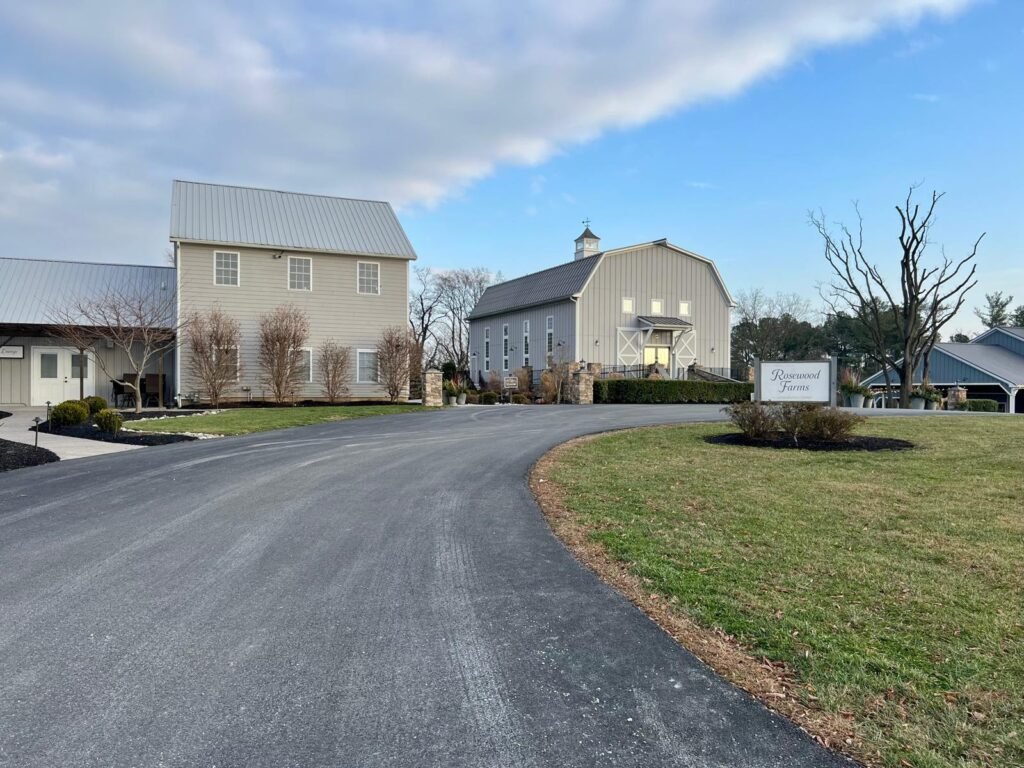
Rosewood Farms, Cecil County, Maryland
Message from the Father of Groom
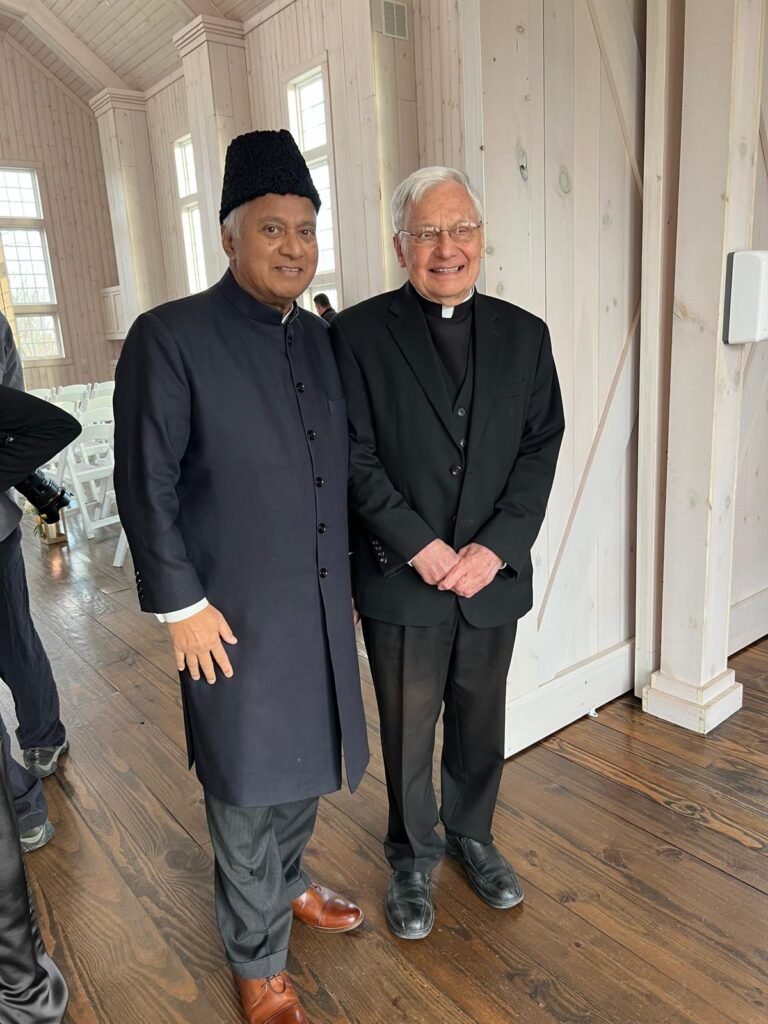
591st Interfaith Wedding | 198th Christian–Muslim Wedding
Wedding Venue: Rosewood Farms, Cecil County, Maryland
Venue Link: https://www.rosewoodfarmsmd.com/weddings/
There is no shortage of wedding venues I have officiated at—ranging from apartments and homes to community centers, banquet halls, parks, gardens, mountains, beaches, barns, farms, airplanes, boats, and memorials (including Jefferson, Lincoln, Washington, and the gazebo at the War Memorial). I have cherished every location. Today, I officiated at Rosewood Farms, marking my fourth wedding in a barn converted into a wedding venue in Cecil County, Maryland.
The venue is 107 miles from my home in Washington, D.C., and it takes about 2 hours and 15 minutes to reach. We texted the couple to inform them that we had left home and would arrive 30 minutes before the ceremony. Fatima, my wife, drives these days, entering the address into the GPS. After passing Baltimore, the GPS directed us to take Highway 1. I preferred to go on I-95, but she insisted we follow the GPS. I didn’t argue since we always reach our destination. However, there were too many traffic lights along the way, which left us ten minutes late.
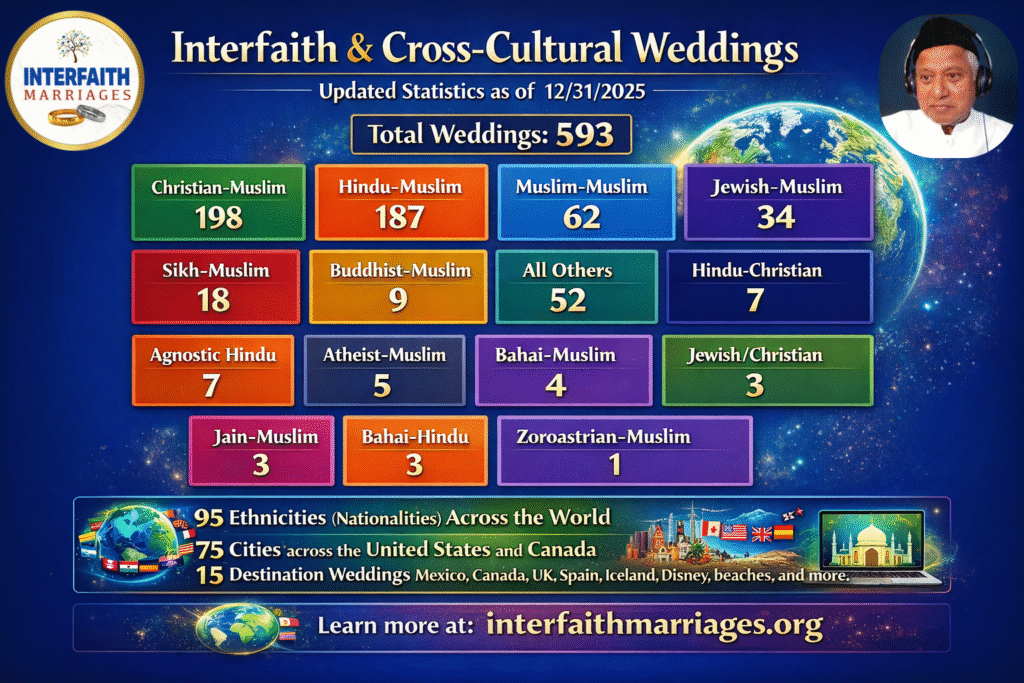
Interfaith Marriage Statistics
This wedding marks my 198th Christian–Muslim ceremony, followed by 186th Hindu–Muslim wedding. Third on the list is 61 Muslim–Muslim Nikah ceremonies, and fourth is 34 Jewish–Muslim weddings.
For more marriage statistics, visit:
https://interfaithmarriages.org/your-rabbi-imam-pastor-or-pundit-for-interfaith-marriages/
Arrival and Ceremony Introduction
Approximately 100 guests were seated and waiting for me, upon arrival, I quickly apologized for the delay. This was the first time in 16 years that I was late; I’ve always made it a point to arrive 30 minutes early.
While waiting for the bride and groom to enter the hall, I typically spend 7 minutes explaining the concept of pluralism, which involves respecting the uniqueness of each of the 8 billion of us. I plan to create a video featuring a 7-minute motivational talk on finding peace within ourselves and with others.
Ceremony Structure and Inclusivity
I begin the ceremony with the bride and groom’s permission and that of their families, followed by a one-minute summary to clarify what will unfold. The ceremony is designed to be inclusive, with families and friends participating rather than merely observing.
Every Arabic word (and Sanskrit if it is a Hindu–Muslim wedding) will be translated into English, and the process will be explained. It is a learning experience about the essence of both their faiths and the common values they share.
Delivery Style and Preparation
Fatima mentioned that I rarely refer to the script in the book; my delivery often feels like a spontaneous conversation. I usually memorize the personalized script, ensuring a fluent delivery.
This reminds me of Yul Brynner, the celebrated actor, who, during his 1000th show on Broadway in The King and I, was asked by a reporter why he still rehearsed. Yul responded, “I want to do better than my 999th show.” Hence, I strive to make each wedding I officiate better than the last.
Although you can find over 50 testimonials on our site, from the bride, groom, and their parents praising the ceremony’s meaningful, and purposeful nature, I always aim to improve.
Integrating Traditions in Interfaith Ceremonies
The Catholic Wedding Ceremony followed the Muslim Nikah Ceremony. I have worked closely with clergy from various faiths. In the absolute interfaith marriages I officiate, the Islamic and Christian traditions run parallel to one another. Every Arabic scripture is matched with Biblical verses.
The same is true for Hindu-Muslim marriages, Jewish-Muslim marriages, and other interfaith unions. For every reference found in Muslim scripture, I can often identify corresponding passages in the texts of Christianity, Buddhism, Hinduism, Judaism, Sikhism, and other religions.
Mike Ghouse
590th Interfaith Wedding | Christian-Muslim
A Saudi-American bride marries an African American groom.
The groom’s parents wanted to speak with me, which I routinely accommodate; in fact, I have talked to over 650 families to ensure everyone is on the same page. The groom’s mother wanted to understand what is involved in an interfaith marriage. She admitted that she had little knowledge about Islam and expressed the belief that only a Christian wedding is legitimate, citing that access to the Father is only through Jesus.
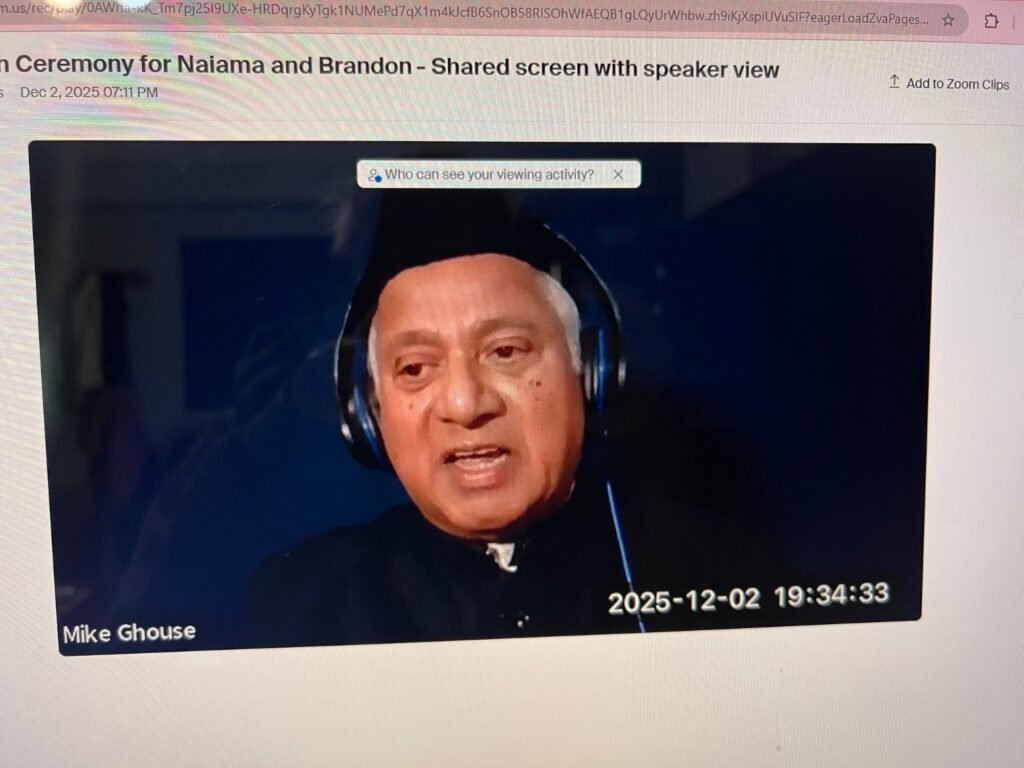
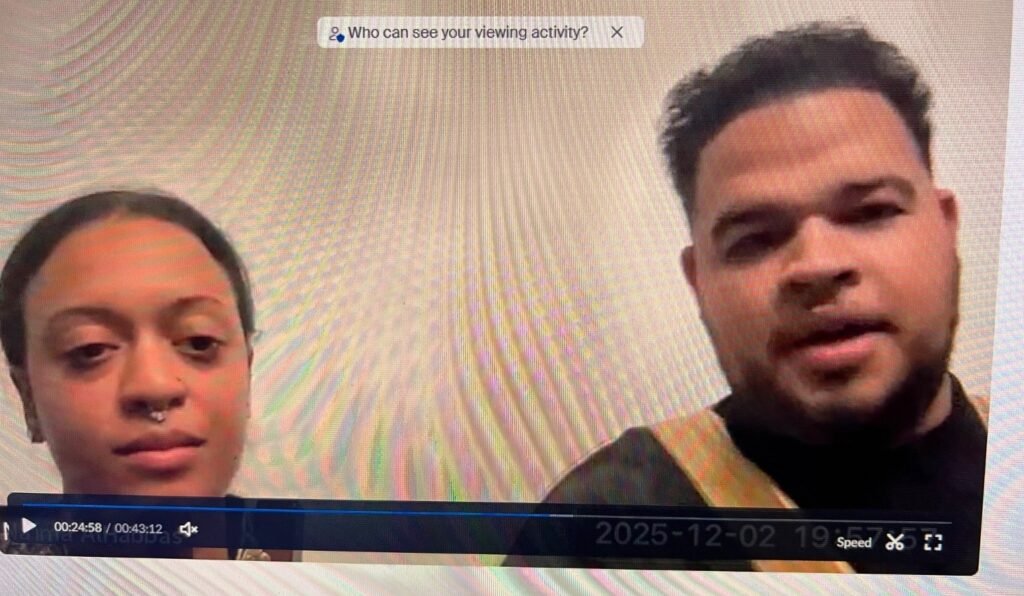
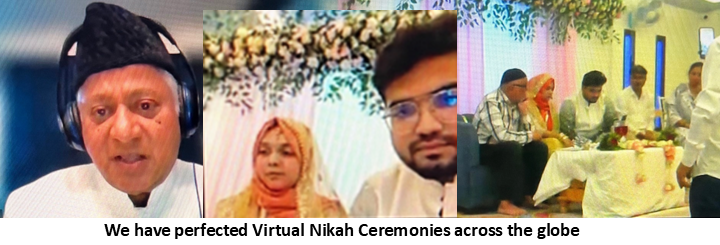
We have perfected our virtual wedding systems, and the ceremony was conducted online. I want to express my appreciation to the couple for their flexibility in rescheduling. Initially, I was supposed to be with them at 2 PM, followed by another in-person wedding at 5 PM in Sterling, Virginia. However, the couple in Virginia moved their wedding time to 3 PM. It wasn’t easy to make this adjustment, but thanks to Naima and Brandon, they agreed to hold their ceremony at 7:30 PM instead. I am happy to share that at least four couples have changed their schedules to accommodate my requests. It feels good that they even changed the date and time.
It was a unique situation, as the bride kept changing the time. As long as everyone is on board with the new schedule, I am more than willing to accommodate changes. I have immense patience and respect for the couple’s wishes and needs.
My role as a Pluralist is to communicate with the families of the couples, and present them with the outlines of the ceremony. In this particular marriage, both the bride and the groom chose a wholesome interfaith ceremony. This means that the entire event incorporates three traditions in parallel: Muslim, Christian, and Civic traditions. Every Islamic scripture recited will be complemented by a corresponding Biblical scripture.
I shared the Essence of Islam and Christianity with them, and they seemed pleased with the information. At the end of the ceremony, the groom’s parents expressed their appreciation by sharing their blessings.
Here is what I shared with them:
Essence of Islam
The essence of Islam lies in the concept of peace, which signifies a state of harmony and tranquility. God has designed the universe to function in perfect order; everything—from the planets and the Earth to the trees, shrubs, and all forms of life—operates according to this divine plan. Unlike the rest of creation, however, God has endowed humans with free will and intelligence.
While our free will can sometimes lead to conflicts within families, communities, and nations, it can also foster tranquility, security, and peace for all of humanity. Therefore, it is our responsibility to create harmony for our well-being. Islam emphasizes, above all else, the healing of the world, justice, charity, and kindness toward others.
Essence of Christianity
Jesus summarizes the essence of Christianity in the Gospels of Mark and Luke. When a religious expert asked Him, “Of all the commandments in the Scriptures, which is the most important?” Jesus provided a straightforward answer: “The first is to love God with all your heart, soul, mind, and strength; and the second is to love your fellow human beings as yourself.”
The moral principles in both traditions share similarities, emphasizing the healing of the world, justice, charity, and kindness toward others.
Mike Ghouse
Snippets from Recent Articles
She Was Covering President Biden. He Was Protecting Him. Love Took Flight.
May 24, 2026
No Comments
Courtesy of The New York Times Here is my 620th Interfaith Marriage, which I officiated, covered by the NYT 40% of our weddings are between doctors, and others
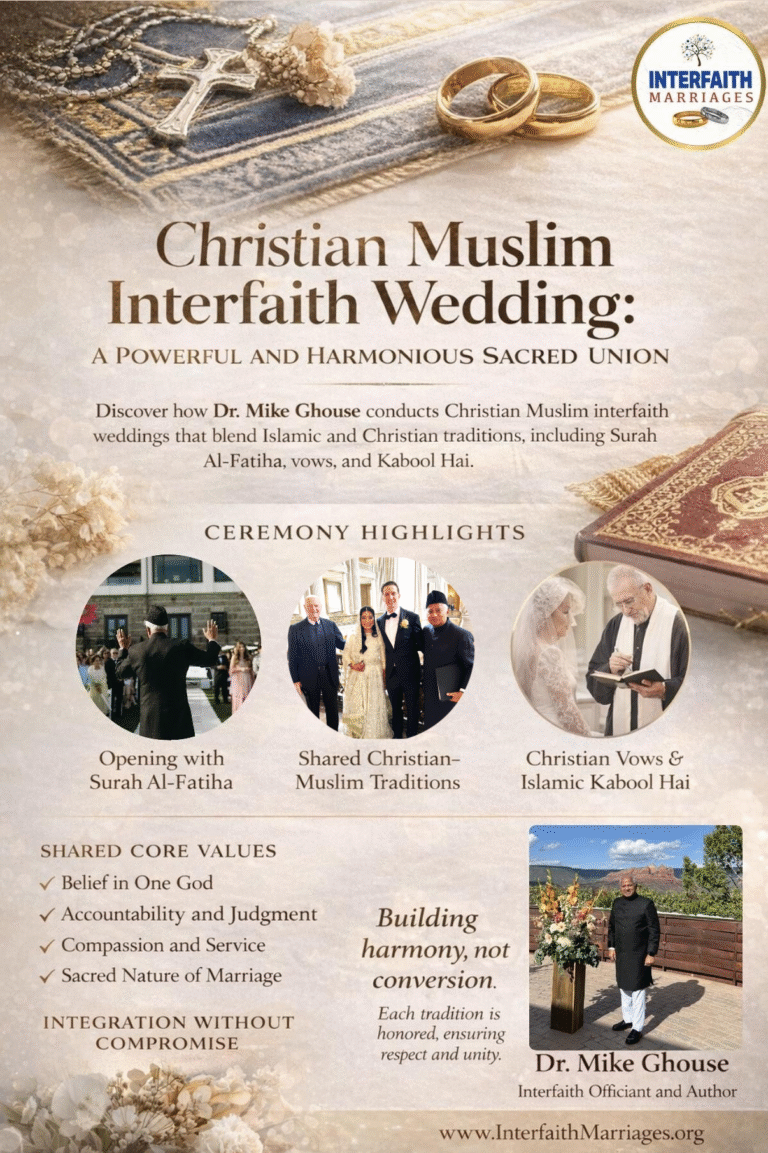
Christian Muslim Interfaith Wedding: A Powerful and Harmonious Sacred Union
March 3, 2026
No Comments
As of December 31, 2025, I have officiated a total of 598 weddings, including 201 Christian-Muslim weddings. A Christian Muslim interfaith wedding is not a
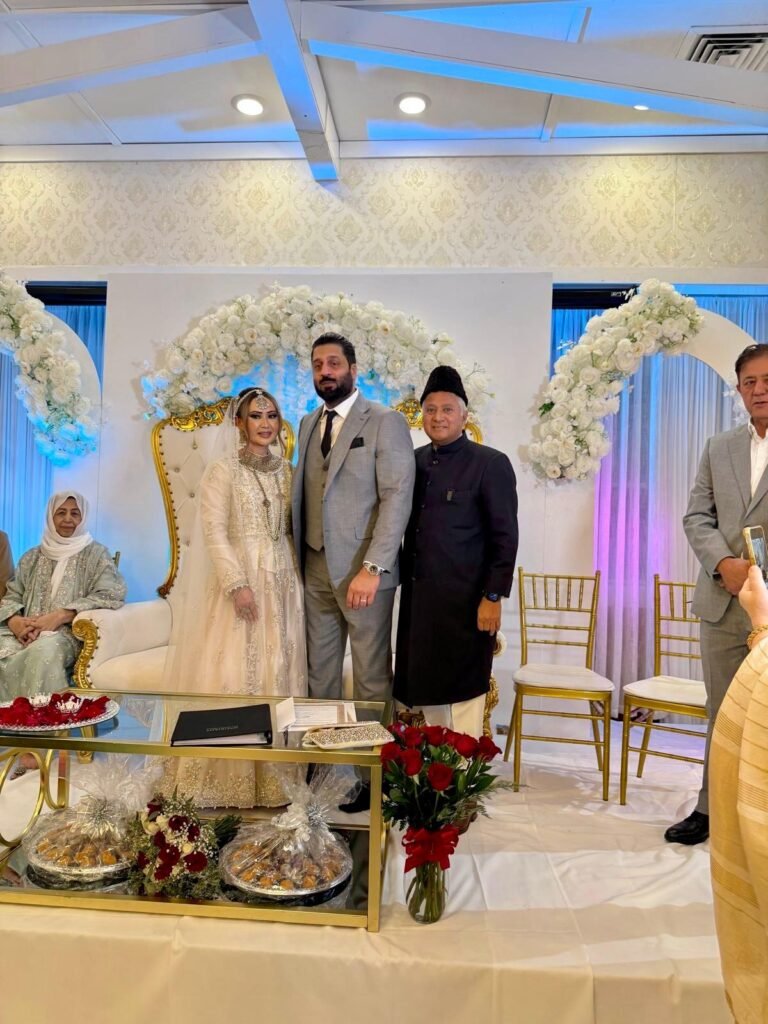
589th Wedding | Muslim-Muslim Wedding
This wedding was between a Pakistani Muslim groom and an Afghan Muslim bride. The groom’s parents are from Pakistan, and he requested that I conduct a part of the ceremony in Urdu; I was able to deliver several sentences and Urdu is my mother tongue. The ceremony is primarily conducted in English, with infusions of verses from Arabic and their translations. We’ve structured the ceremony in steps, making it easier for our kids to understand what a Muslim nikah is and how it is officiated.
It amazes me that not only Muslims but also non-Muslims perceive the Nikah ceremony as simply “Qabool, Qabool, Qabool” repeated three times, which is indeed a crucial part of it. However, it also encompasses key requirements of free will: optional family blessings, Mahr, Ijab o Qabool (Acceptance), signatures of the bride, groom, guardian/wakil, witnesses, and officiant. This is followed by the Qutba (Sermon), duwa (prayers), a public announcement, and Walima (dinner).
A revived cultural trend is to have a flower screen placed between the bride and groom. The groom enters with his parents and sits on one side of the screen, while the bride enters with her parents and sits on the other side. After they accept each other as husband and wife, reciting “Qabool” three times in response to the question, “Mr. Groom (name), do you take the bride as your wife per Muslim religious traditions?” and vice versa, the groom walks through the screen to hug the bride.
The groom is also offered the opportunity to sing a line or two from his favorite romantic song as he walks through the screen. Additionally, we incorporate various civic traditions, such as bridesmaids, groomsmen, flower girls, and a ring bearer, depending on the couple.
No wedding is the same; we customize each ceremony to include the couple’s cultural traditions as elaborate or as simple as they want. We also speak with parents for their support.
Of the 589 interfaith weddings I have conducted, this was my 61st Nikah ceremony between two Muslims, encompassing ceremonies from nearly all denominations (Madhabs). Twenty-four years ago, I wrote on the website of the World Muslim Congress, a think tank dedicated to promoting acceptance and respect among Muslims of different belief systems.
A Muslim is a Muslim is a Muslim
“At the World Muslim Congress, we make no distinction between one Muslim and another. If you believe in God, are accountable for your actions, treat others as equals, and act justly, mercifully, and kindly towards all of creation, you are a Muslim. If we were to define God’s will, it is simply to preserve and maintain harmony within His creation.”
I thank God for allowing me to be an instrument of cohesion in the Aalameen (Universe) and for enabling me to live up to the statement I made 24 years ago. I am pleased to share that I have officiated Nikah ceremonies for Muslims from various backgrounds: Shia, Sunni, Bohra, Ismaili, Ahmadi, Sufi, and the Nation of Islam. There are several more, but these are the main denominations, each with its own further sub-groups.
Mike Ghouse
588th Interfaith Marriage | Muslim-Jewish Wedding
2nd Disney Destination Wedding
The Rabbi and I officiated this beautiful interfaith marriage between a Jewish groom and a Muslim bride. Collaborating with diverse religious leaders, including those from Hindu, Catholic, and Protestant backgrounds, has strengthened my ability to create meaningful ceremonies. This experience will inspire confidence in couples seeking an inclusive officiation.
It was my 34th Jewish-Muslim wedding and 7th co-officiated with a Rabbi, a part of serving with Pandits, Pastors, Rabbis and others. The statistics is at
Marriage Statistics: Co-officiating with Rabbis, Pastors, Fathers, Priests, Pundits, Imams, and other religious leaders.
Interestingly, both ceremonies were identical, featuring similar blessings. I officiated first, and then the Rabbi took his turn, which I observed closely. The ceremonies were conducted in English, with insertions of Arabic and Hebrew.
The Muslim Nikah contract is similar to Jewish Ketubah; in fact, Muslims also refer to it as a Ketubah. We crafted a memorable moment out of the signing of the documents, with the groom’s and the bride’s close relatives having relaxed conversations.
We all sat around a long table to sign the documents, accompanied by the Wali and two witnesses. Both documents needed two witnesses. The Muslim witnesses can be any two individuals, whereas the Jewish witnesses have to be non-relatives. There is a reliable value in both traditions, the Rabbi said, if there is a dispute between the couple, a relative’s witness would be biased. In the Muslim tradition, one must tell the truth, even if it goes against oneself or one’s family; truth is a higher value to be upheld to build secure societies.
I particularly enjoyed this part. As I explained the Muslim Ketubah, the Rabbi explained the Jewish Ketubah. At the end, he recited a Jewish prayer referencing Abraham, to which I responded with the Darood-e-Ibrahimi, or Darood Shariff. This is an inclusive prayer honoring Prophet Abraham and his progeny, including Moses, Jesus, and Muhammad (peace be upon them).
The wedding took place at a beautiful resort spread over hundreds of acres within the Disney compound in Orlando.
Destination weddings are becoming increasingly popular, with locations such as Cancun, Tulum, Cozumel, Mexico City, Canada, Scotland, England, Iceland, and Spain among the favorites.
One challenge I encounter with destination weddings is the quick turnaround—landing in the morning, performing the wedding, and returning in the evening. I am actively working to ensure that the experience is as memorable as the ceremony itself. My goal is to make destination weddings more immersive and enjoyable for everyone involved, including my wife, Fatima.
I have also earned a spot as a wedding officiant at Disney, and they have featured my photo officiating a previous wedding. This recognition reflects my commitment to excellence, and I hope it reassures prospective clients of my professionalism and dedication.
With 30 years of experience at the Center for Pluralism, conducting workshops, giving lectures, and writing about 12 religions and multiple denominations, I am well-equipped to craft ceremonies that honor diverse backgrounds, making clients feel understood and respected.
Mike Ghouse
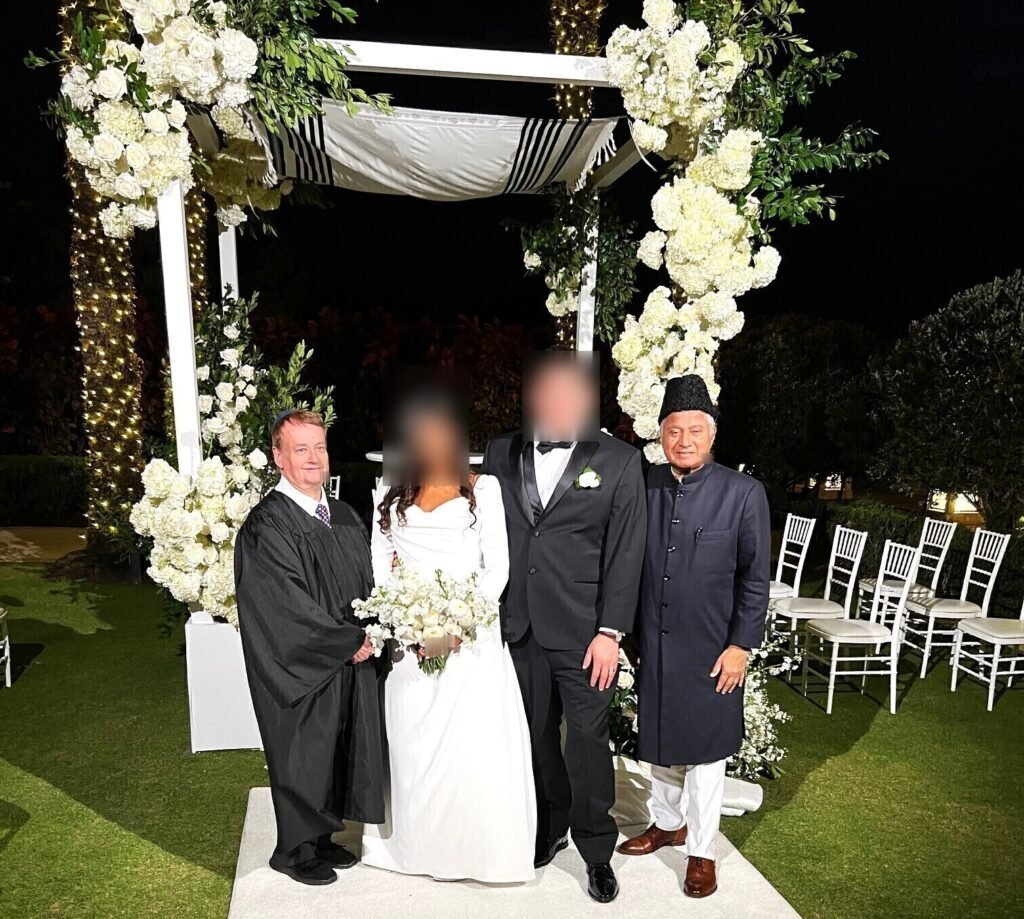

Here is a note from the couple,
Salam Mike,
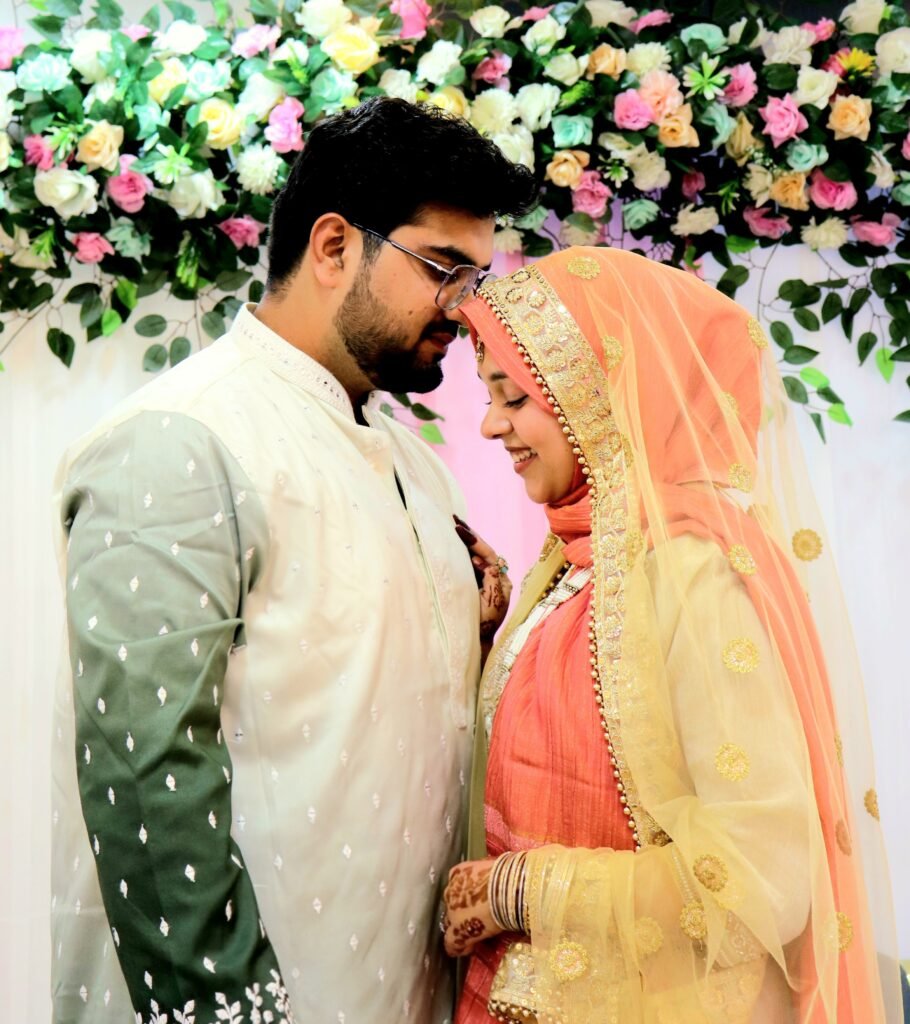
I hope you are doing well. My husband and I wanted to extend our deepest gratitude for officiating our Nikah and for making it one of the most memorable days of our lives. The ceremony was more beautiful and heartfelt than we ever imagined, and we are truly thankful for the care and sincerity you brought to it.
Everyone who attended — including our parents — went home extremely happy. My friends were also so impressed that one of them even asked for your contact information so they could reach out to you for their own Wedding.
Thank you once again for being such an essential part of our special day. We are genuinely grateful.
Warm regards,
Saima and Mushtaq
587th Wedding: 60th Nikah
It’s the 60th Nikah (between two Muslims) among the 587 weddings; the others are interfaith, between 12 different religions, 95 ethnicities, and all four races. More stats at
Marriage Statistics: Co-officiating with Rabbis, Pastors, Fathers, Priests, Pundits, Imams, and other religious leaders.
Although both individuals are Muslims, they come from two different traditions. It took two conversations with each set of parents for them to accept the relationship. I approach everything I do with full commitment and see it through to the end. I have officiated Nikah ceremonies across major Muslim denominations (madhabs), including Shia, Sunni, Bohra, Ismaili, Ahmadi, and Sufi, and there may be others that I am not yet familiar with.
Nikah signifies the union of two individuals. God loves for people to marry and live in harmony, and I would like to share the verse from the Quran (30:21).
وَمِنْ آيَاتِهِ أَنْ خَلَقَ لَكُم مِّنْ أَنفُسِكُمْ أَزْوَاجًا لِّتَسْكُنُوا إِلَيْهَا وَجَعَلَ بَيْنَكُم مَّوَدَّةً وَرَحْمَةً إِنَّ فِي ذَٰلِكَ لَآيَاتٍ لِّقَوْمٍ يَتَفَكَّرُونَ
“And among His signs is that He created mates for you from among yourselves so that you may find tranquility in them; and He placed between you love and compassion. In these are signs for people who reflect.” (Quran 30:21)
Mike Ghouse
Reflections: 586th Wedding in Orlando, Florida
A special thanks to the groom’s Egyptian family and friends, as well as the bride’s English and Colombian friends, who honored the mosque’s traditions. The groom’s parents, originally from Egypt, incorporated several Egyptian customs into the ceremony. One such tradition involved reciting the 99 names of God (with 99 symbolizing infinity), each representing an attribute of the divine. Additionally, Nasheeds—poetry that praises the merciful messages of the Prophet—were played at the beginning and end of the ceremony.
As the Nasheeds played, the groom entered with his parents, followed by the bridesmaids, the groom’s men, and lastly, the bride with her parents. The bride’s Catholic family honored the Mosque tradition by covering their hair, just as Mother Mary did.
This was the 59th Nikah ceremony I officiated between two Muslims. Some participants were born Muslim, while others had converted after studying intensely about Islam and reading articles on our website and in the book “American Muslim Agenda.” It is important to note that no one should convert solely for marriage, as Islam forbids conversion by compulsion. One of the strongest values in Islam is truthfulness, which is emphasized in 852 verses of the Quran. The importance of truthfulness remains relevant even after marriage.
Since the bride was raised in this tradition, it was a joy to incorporate elements of Christian values into the Nikah ceremony. Islam is not a new religion; it shares teachings that have been passed down through Abraham, Moses, Jesus, and Muhammad (peace be upon them). This universality can be found in all religions, including a belief in a creator who initiated the universe, accountability for one’s actions—where no one escapes the outcome—adherence to values that promote inner peace and harmony, and the importance of caring for one another. By getting to know each other, we can diminish conflicts and foster peace. God loves us and expresses that love through values like truthfulness, which brings us peace and tranquility.
Truth is one of the most sacred values in Islam and is perhaps the most enduring virtue found across all religions, social systems, and governance models. The well-being of any society is sustained by truth alone. Truth serves as the solid foundation upon which secure communities are built. For more about this, visit: [Truthfulness in Islam].
India’s emblem includes the phrase “Satyameva Jayate,” which means “Truth Triumphs” and reflects a notion similar to our own emblem, “E Pluribus Unum.”
Out of the 586 weddings I have officiated, 59 were between Muslims. Some of the stats are included in Your Rabbi, Imam, Pastor or Pundit for Interfaith Marriages – Wedding Statistics
Mike Ghouse
585th Wedding: 9th Bohra Wedding
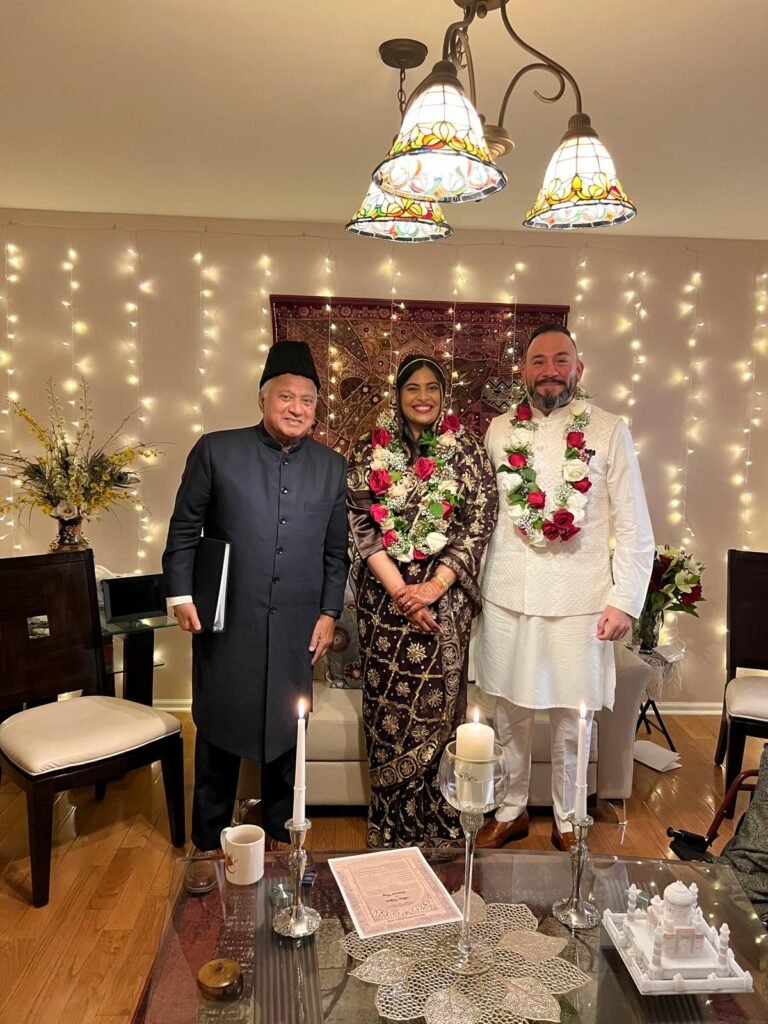
This is my ninth Bohra wedding, and I’ve traveled by train to various cities for most of them, including New Haven, New York, Philadelphia, and Boston. My first wedding was a Bohra and Hindu ceremony in Chicago, followed by a Bohra and Christian wedding in Farmington, a wedding in Austin, and now this ninth ceremony in Langhorne, PA, which was again a Bohra Muslim-Christian event.
In a unique twist, the bride had the Duwa and benediction read by their mothers, while the fathers lit the unity candles. The Unity Candle ceremony symbolizes not only the union of the bride and groom but also the joining of their families. This interfaith ceremony included verses from 1 Corinthians, the Lord’s Prayer, and teachings from Jesus about marriage. It also featured role models from the Muslim faith—Prophet Muhammad (pbuh) and Bibi Khadija.
A common custom in all Bohra ceremonies is the Aarti, where a silver plate holding a small diya (flame) is moved in a circular motion in front of the bride and groom. This practice is meant to ward off the evil eye and bring peace and prosperity to the couple.
The groom’s family has roots in Mexico, while the bride’s family is from Tanzania. The groom’s family settled in Austin about 150 years ago, while the bride’s family moved to New York around 50 years ago.
The wedding took place in their living room, and I appreciate these smaller, more relaxed celebrations.
For dinner, they served Gujarati food, which I have come to enjoy, although I was surprised by its spiciness. Normally, I rush to the airport immediately after the ceremony, but on this occasion, I had two hours to catch the train in Trenton, NJ, so I joined the family for dinner. During the meal, the bride’s father shared fascinating details about Tanzania, including a massive crater 250 feet deep and several miles in diameter, home to various animals and even some tree-top homes. They communicated in Swahili, Gujarati, some Urdu-Hindi, and much English. Interestingly, Swahili incorporates several Arabic and Urdu-Hindi words, and it also shares similarities with Spanish.
Both the bride and groom were tall; he stood at 6 feet, and she was 5 feet 10 inches—what a beautiful couple! They are also among the most compatible couples I noticed during my first Zoom meeting.
Mike Ghouse
Reflections: 584th Wedding
Each wedding is designed to be unique, reflecting the couple’s personal faith and culture. A highlight of this wedding was that a Jewish woman, a friend of the bride, organized the entire event in her backyard. A wooden deck was constructed to provide a flat surface in the uneven backyard, leading down to a stream. Additionally, the bride led the Asr (evening) prayer.
About 75 guests sat on the ground, with carpets and sheets spread over the grass, and the bride had sourced beautiful pillows for everyone to sit on. Each of the bride’s friends contributed a dish for a late lunch, creating a delicious variety of food for everyone to enjoy
Mike Ghouse

583rd Wedding: 18th Sikh-Muslim Wedding
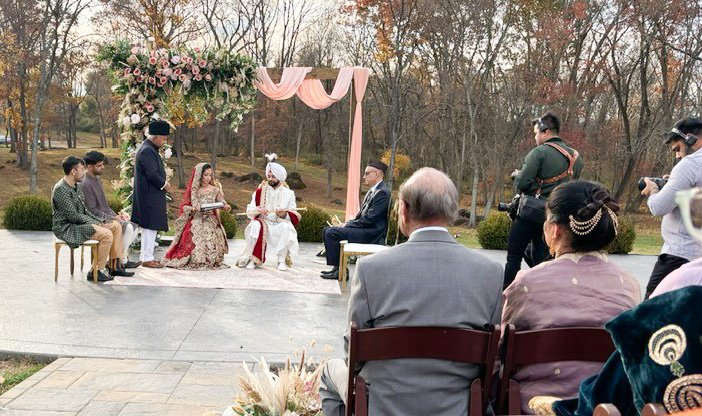
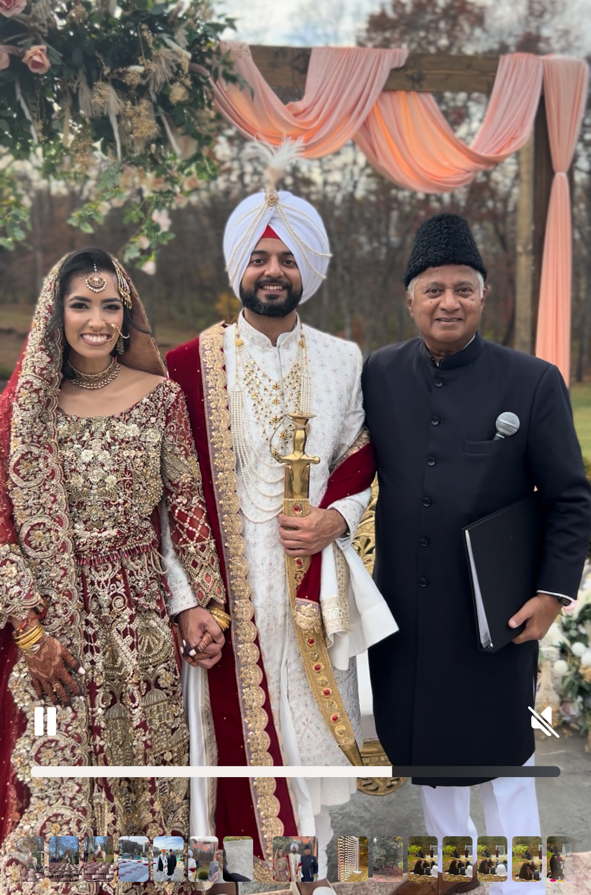
Officiating my eighteenth Sikh-Muslim wedding continues to bring me joy, as it allows for the thoughtful integration of Sikh, Muslim, and civic traditions into a cohesive interfaith ceremony.
Punjabi weddings are traditionally elaborate, often spanning three days. The groom typically arrives on a white horse during the Baraat/procession, accompanied by family and friends who dance along the route. Increasingly, other South Asian communities from the Indian subcontinent are adopting this vibrant format, even if the horse is not always included.
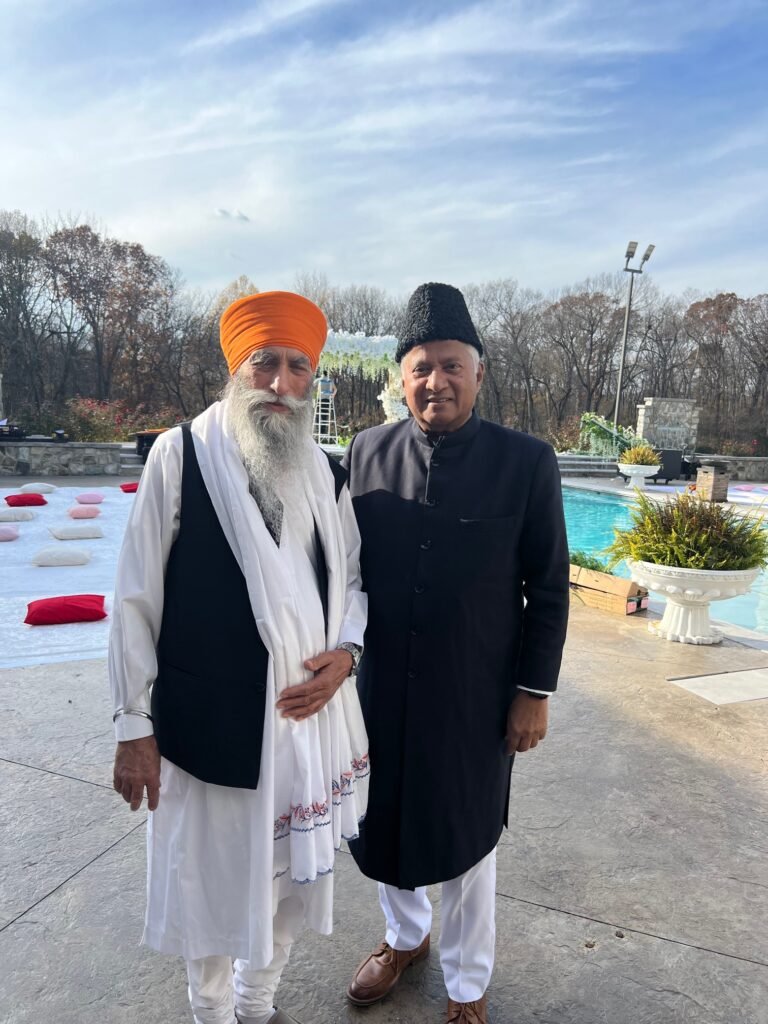
Approximately 250 guests attended the two back-to-back ceremonies. The first was the Nikah ceremony, which I officiated. In the Muslim tradition, Nikah signifies the union of two souls, as described in the Quran. Following the Nikah, the Anand Karaj, or blissful union, was conducted by the Gyani Saheb in accordance with Sikh tradition. I value the feedback received from both Muslim and Sikh families and friends; for many, this was their first experience with a Muslim-Sikh interfaith marriage, and they expressed appreciation for the clarity and inclusivity of the event. Celebrating together fosters a sense of shared joy and community.
I dedicate time to interviewing each couple to understand their preferences and early perceptions of marriage. I present various ceremony options, and together we select elements that best reflect their values as we prepare the script.
Often, I include parents in the discussions, as it is not only the union of the bride and groom but also their families.
Guests often express appreciation for my officiating style, noting that it is frequently the first time they have fully understood a ceremony. I prioritize clarity by explaining each step in accessible language, ensuring that participants of all ages remain engaged. Testimonials from attendees on the website further demonstrate my commitment to creating meaningful and inclusive ceremonies.
Mike Ghouse
582nd Wedding: What sets this wedding apart?
Many attendees, who primarily spoke Telugu, were experiencing a Muslim Nikah ceremony for the first time—though a few had attended such ceremonies before. They noted that, whether at a Hindu or a Muslim wedding, the officiant would often recite prayers in Sanskrit or Arabic without explanation.
Guests appreciated that the ceremony began with a clear one-minute summary, followed by explanations for each step. This clarified the meaning behind each action or phrase, helping everyone understand the purpose. People took away different things: some enjoyed the humor throughout, while others valued the explanations of the ten steps and the connections made between the Bhagavad Gita and the Quran.
At the end, both mothers recited from their scriptures, while the groom’s father recited the Gayatri Mantra, and the bride’s father recited Sura Ikhlas—since both passages have identical meanings repeated three times—and then I translated the verses. This approach helped illustrate the shared monotheistic beliefs. For further insight, consider the question: Is Hinduism a monotheistic religion?
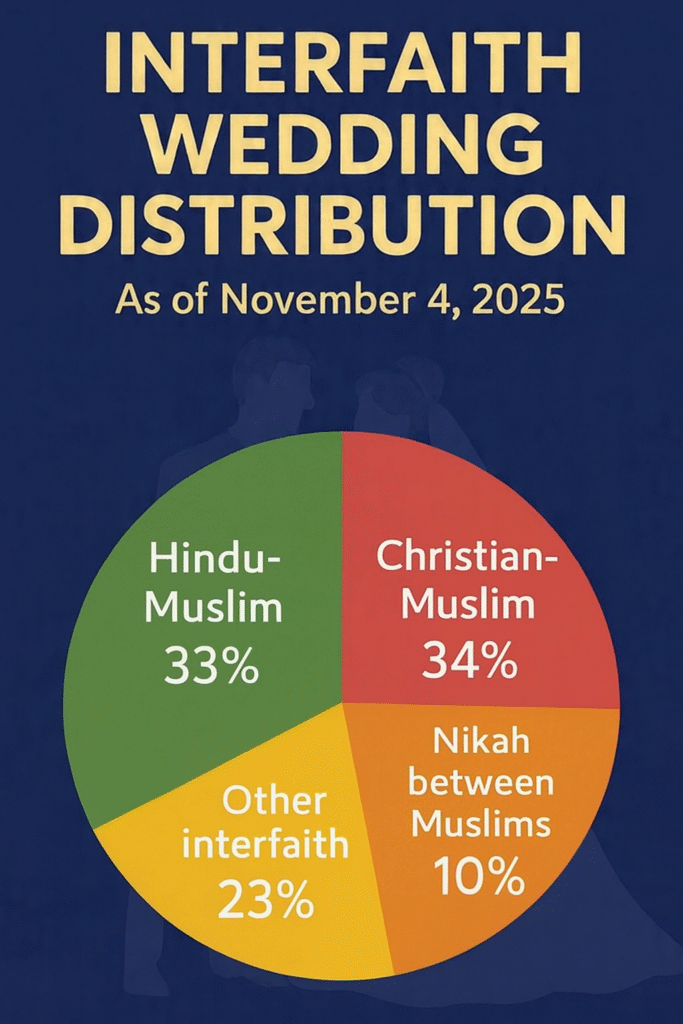
As of 11/4, I have officiated 582 weddings, including 195 Christian-Muslim, 186 Hindu-Muslim, 67 Muslim-Muslim, 33 Jewish-Muslim, 17 Sikh-Muslim, 9 Buddhist-Muslim, 7 Hindu-Christian, 7 Agnostic-Hindu, 5 Atheist-Muslim, 4 Bahai-Muslim, 3 Jewish-Christian, 3 Jain-Muslim, 3 Bahai-Hindu, and one Zoroastrian-Muslim.
The 582nd interfaith wedding took place in Houston, Texas.
Mike Ghouse
Speaking with Families
Meeting with Nana: Reflections on Faith and Sharia
The meeting with your Nana (maternal grandfather) clarified his views on the central distinctions between Wahdaniyat (God’s Oneness) and the differences he identified between Sharia Muhammadi, Sharia Esa, and Sharia Musa.
Insights from Interfaith Conversations
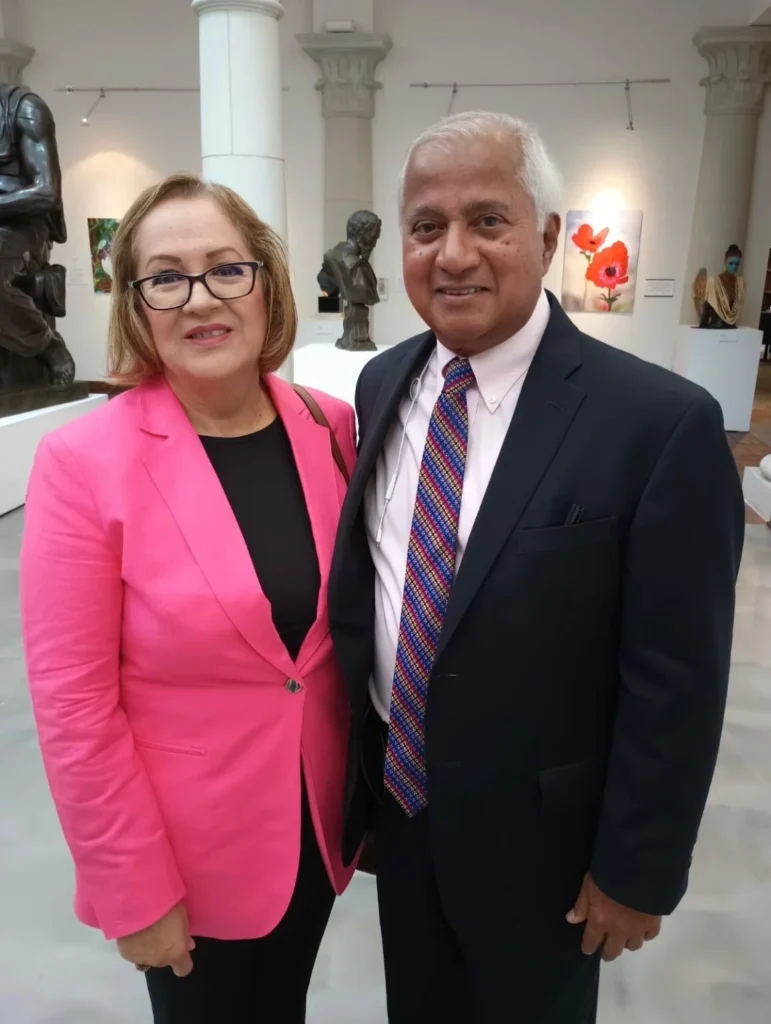
From conversations with over 650 families of diverse backgrounds, I summarize here key reflections drawn from interfaith discussions, especially with Hindu and Muslim families.
Shared Beliefs and Universal Values
Your Nana fully agreed with the basic requirements of faith:
Belief in God
Accountability for one’s deeds (the Day of Judgment)
Caring for fellow human beings
I shared Muhammad Asad’s exegesis of verse 2:262 — “Who is a Muslim and What is Islam”, located at the Interfaith Marriages site.
Clarifying Sharia Requirements in Nikah Ceremonies
He asked for specific Sharia requirements will be met, which are integrated in our Nikah and Nikah+ ceremonies. These are:
Free will, Family blessings, Common Sense gift known as Mahr..Ijab o Qabool (acceptance of each other as husband and wife, Relevant signature, Sermon, Duwa/Prayer, Public announcement, and Walima/reception.
We then tailor the ceremony to honor the couple’s own traditions, ensuring all attendees understand its meaning.
Faith, Shahadah, and Sincerity
He wanted the groom to take Shahadah as a pledge. I stressed the sincerity of faith, the absence of compulsion, and truthfulness as foundational principles of Islam.
Truthfulness remains a core value in Islam, as further explained at the World Muslim Congress.
Prophet’s advice: “Become a model Muslim, inspiring others to emulate, and not by pressure.”
Shared Acceptance Among Traditionalists
Surprisingly, the traditionalist Nana accepted the idea that God sends Prophets, Avatars, Tirthankaras, Shamans, Gurus, Peacemakers, and Guides to humanity across nations and times, and agreed to a simple acknowledgement that Muhammad (pbuh) was the last prophet in the line of the prophets in Islam, which the couple had agreed to.
Blessing and Closing Reflection
Finally, he blessed the couple with a Duwa (prayer) — Sura Ikhlas (a chapter from the Quran).
Interestingly, it is similar to the Gayatri Mantra, symbolizing harmony between faiths.
Mike Ghouse
Wedding & Nikah Officiant
581st Wedding: Marriage in Toronto
Sunday, October 26, 2025, Toronto, Canada. Today, I officiated my 581st interfaith marriage in Canada. It has become a familiar part of my life. The flight was quick —I was on and off the plane in just an hour and a half. Unless I’m traveling to the West Coast, from Vancouver to San Diego, and everywhere in between, I usually fly in and out on the same day.
I was excited when I saw the wedding hall setup. There were about seven round tables on each side, and right in the center was a flower screen where the bride and groom would sit facing each other. There was also a spot for me to stand or sit. It was one of the best arrangements I’ve seen. I could face both the bride and groom, with my back to the wall instead of the guests. I even took a video to use as an example for future weddings.
The flower screen is an old tradition among some Hindu and Muslim families. A long time ago, marriages were arranged, and the bride and groom did not meet until the wedding. In the old days, they used a designer cloth screen that came off when the baraat (groom’s party) arrived; the groom was teased with questions or a ransom was demanded, upon which he got to see the bride for the first time. The other option is “Mu Dikhaee,” which is when the couple accepts each other as husband and wife, uttering the word Qabool (I do), and the groom lifts the veil of the bride through a mirror and sees her for the first time.
But the new trend among Muslims is that the groom will walk through the screen upon saying ‘Qabool’.
Every wedding is planned with the couple in mind, respecting their cultures, religions, and preferences. I always encourage them to include some traditions their parents value. After all, a wedding brings together not just the bride and groom, but also their families and friends.
Fatima & Mike Ghouse
The flower screen is an old tradition among some Hindu and Muslim families. A long time ago, marriages were arranged, and the bride and groom did not meet until the wedding. In the old days, they used a designer cloth screen that came off when the baraat (groom’s party) arrived; the groom was teased with questions or a ransom was demanded, upon which he got to see the bride for the first time. The other option is “Mu Dikhaee,” which is when the couple accepts each other as husband and wife, uttering the word Qabool (I do), and the groom lifts the veil of the bride through a mirror and sees her for the first time.
But the new trend among Muslims is that the groom will walk through the screen upon saying ‘Qabool’.
Every wedding is planned with the couple in mind, respecting their cultures, religions, and preferences. I always encourage them to include some traditions their parents value. After all, a wedding brings together not just the bride and groom, but also their families and friends.
Fatima & Mike Ghouse


580th Wedding: It's Philadelphia for the 7th time
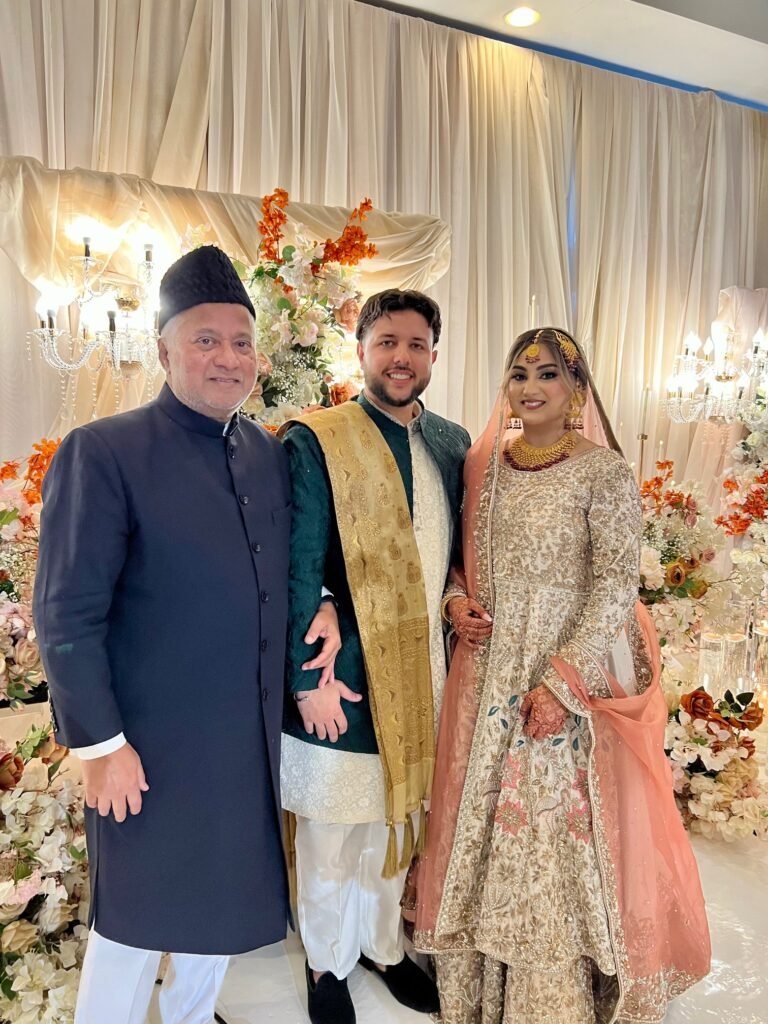
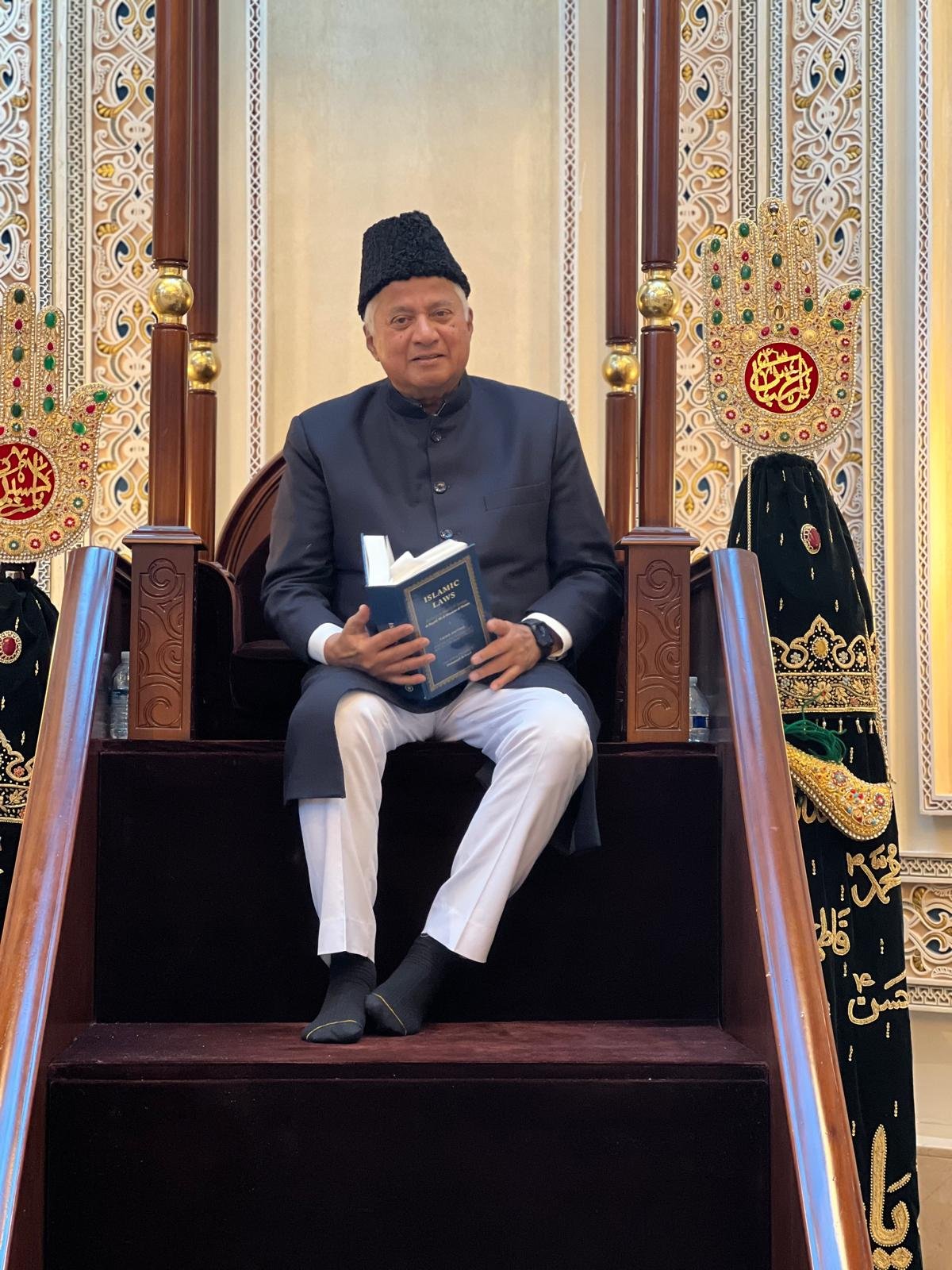
It’s Philadelphia for the 7th time and the 20th wedding in Pennsylvania. Fatima and I enjoyed traveling on the train.
Unlike many other weddings where the clergy recites scriptures in Arabic, Sanskrit, or Latin, I ensure everyone understands the ceremony. Every word from Arabic or Sanskrit is translated and explained in English, making the ceremony accessible to all while respecting religious traditions.
I enjoy writing the full script to include the values and traditions of the couple’s faiths and cultures. It is a union of the couple, families, and friends. The couple and I revise the script to reflect both families’ values. In the end, it is what the couple and families want.
I love this bride. Over the past two years, we have worked together, and she has made over 10 changes, even on the train. I usually do not print updates; instead, I handwrite additions and changes. When I entered the hall, the bride’s mother was waiting for me. We reviewed the ceremony together. She said she had read the script but wanted to add more, and they were good suggestions that I incorporated in the last minute.
During the ceremony, I watch the bride, groom, and their parents to understand their nonverbal cues. My goal is for everyone to enjoy the ceremony.
Fatima & Mike Ghouse
579th Wedding: Timeless Quran
The timeless Quran encourages individuals to live in the present and guides them to see the universe as a unified whole when its verses are interpreted in today’s context. I have witnessed this transformation repeatedly with nearly 300 Muslim families out of the 650 families I have spoken with. These families range from conservative parents to Sharia teachers, including those from Saudi Arabia, Iran, Egypt, Syria, Pakistan, Bangladesh, India, Ethiopia, Yemen, Cambodia, Indonesia, and other nations of the world.
They agree that the Quran is about progressive values aimed at fostering cohesive societies. Most of them recognize that it does not prohibit their children from marrying non-Muslims. It is God who instills love between two souls from among the 8.5 billion of us, so that individuals can come together and live in tranquility, peace, and harmony.
Alhamdulillah—praise the Lord for His blessings, as He makes extraordinary things happen. I am grateful to be an instrument in opening people’s hearts and minds to one another, fostering harmony and tranquility.
Today, I officiated my 579th interfaith wedding in Raleigh, North Carolina. Of the 579 weddings, 193 are Christian-Muslim unions, 185 are Hindu-Muslim marriages, 67 are Nikahs between two Muslims, 33 are Jewish-Muslim marriages, 17 are Sikh-Muslim marriages, 9 Buddhist marriages, and there are other combinations such as Hindu-Christian, Hindu-Jewish, Jewish-Christian, and those with no particular faith. Thus far, we have celebrated weddings among 80 ethnicities, 11 religions, and all races.


578th Wedding: Flower Screen
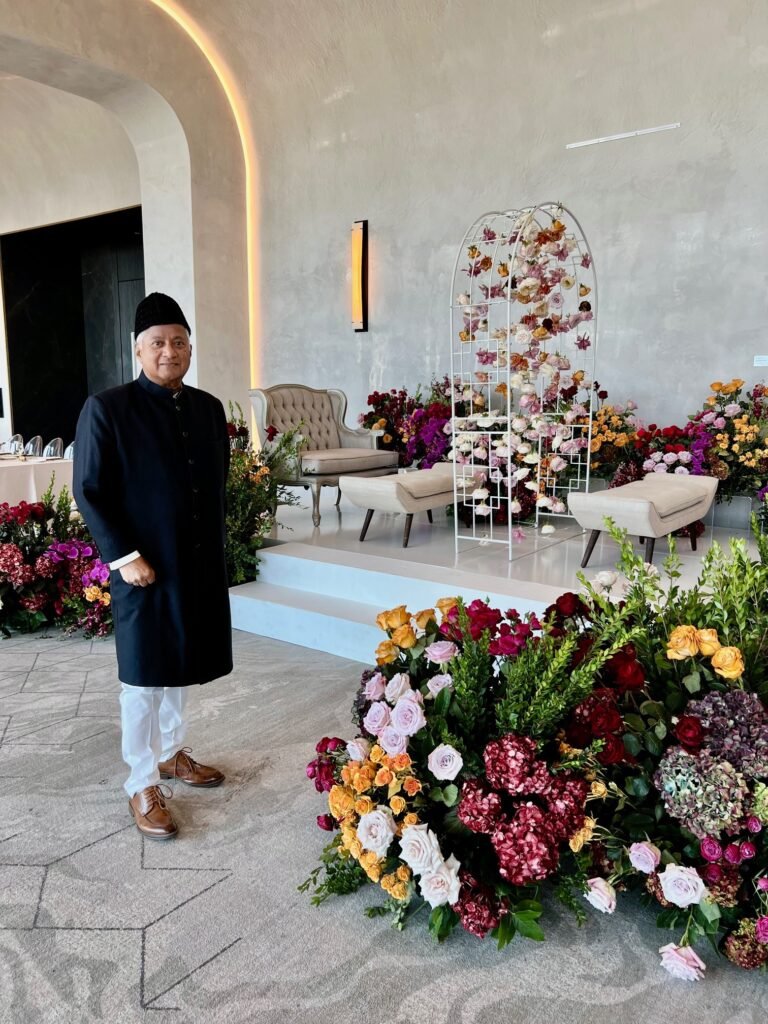
Flower screens at weddings where one of the spouses is Muslim are becoming increasingly common, with approximately every fourth wedding now featuring this element. This trend was not prominent before COVID-19, but since Amazon introduced affordable silk flower options, many couples have started opting for it.
Historically, marriages were often arranged, and the bride and groom would see each other for the first time on their wedding day. The tradition of using a screen between them during the ceremony allows for a dramatic reveal when the screen is removed to celebrate their union.
This was the best setup, I was facing the couple with my back to the audience. It was a narrow hall with the couple and me in the center.
Mike Ghouse
Weddings at Lincoln Memorial 576 weddings between 11 faiths, 80 ethnicities, all races, across America and Canada, and destination weddings.
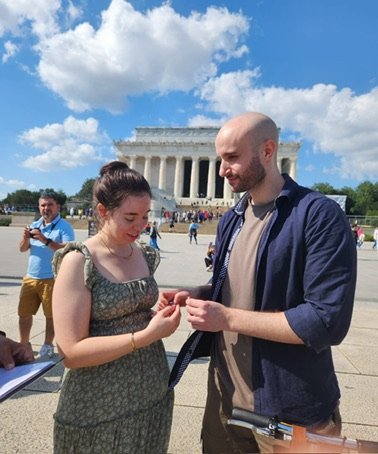
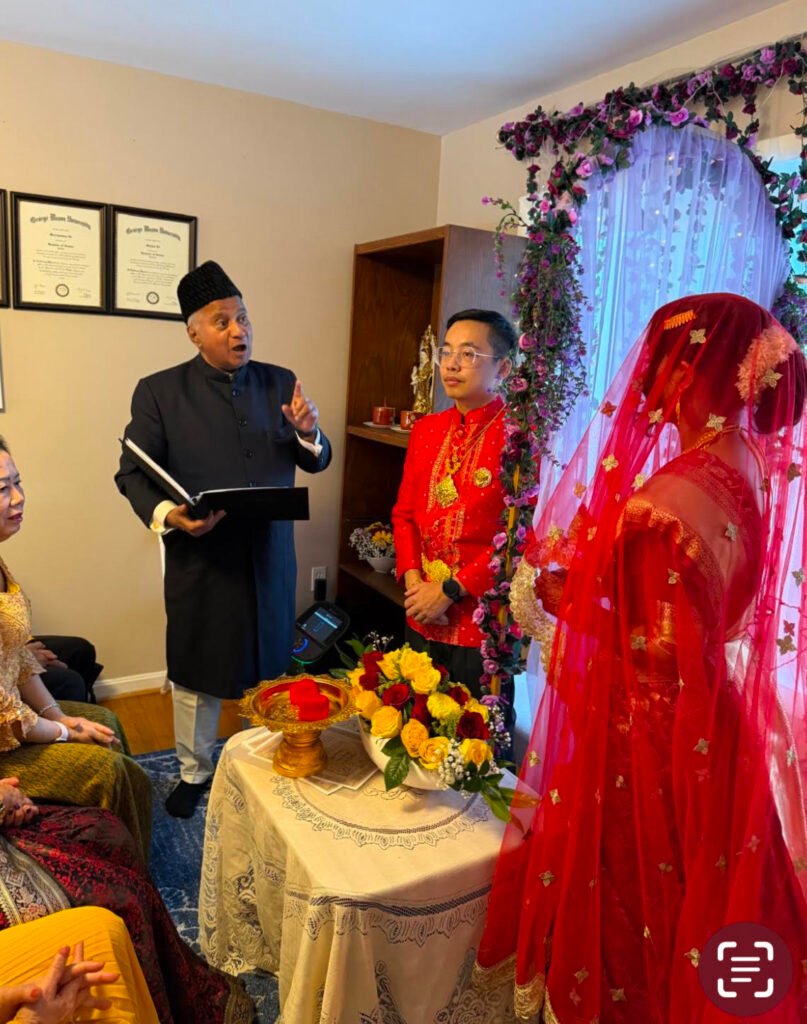
MY DREAM WEDDING
One of the grooms wrote, “Thank you so much. The ceremony was wonderful, and it really meant something to me, which says a lot because I’m not religious.”
During the 475th and 476th weddings I officiated in Chicago over the weekend, the couples chose to have full interfaith ceremonies that honored their diverse traditions.
The 476th ceremony was a beautiful blend of Jewish, Muslim, and Hindu traditions. I feel truly blessed that couples trust me to perform multi-faith, interfaith, inter-ethnic, and interracial weddings.
The 15th multi-faith (5 Faiths) wedding I conducted took place in New York, incorporating values from Jewish, Sikh, Muslim, Hindu, and Christian faiths. This represents my dream wedding—a celebration of pluralism that respects all religions and people, allowing everyone to walk away with an appreciation for different traditions.
I enjoy leading a 7-minute mini-workshop on pluralism, and I love seeing the guests nodding in agreement and joy. The workshop is titled “Embracing Pluralism for a Peaceful Life,” and it addresses the questions: What do I stand to lose, and what is the core essence of our practices?
In defense of Islam, Pursuing A Civil Dialogue
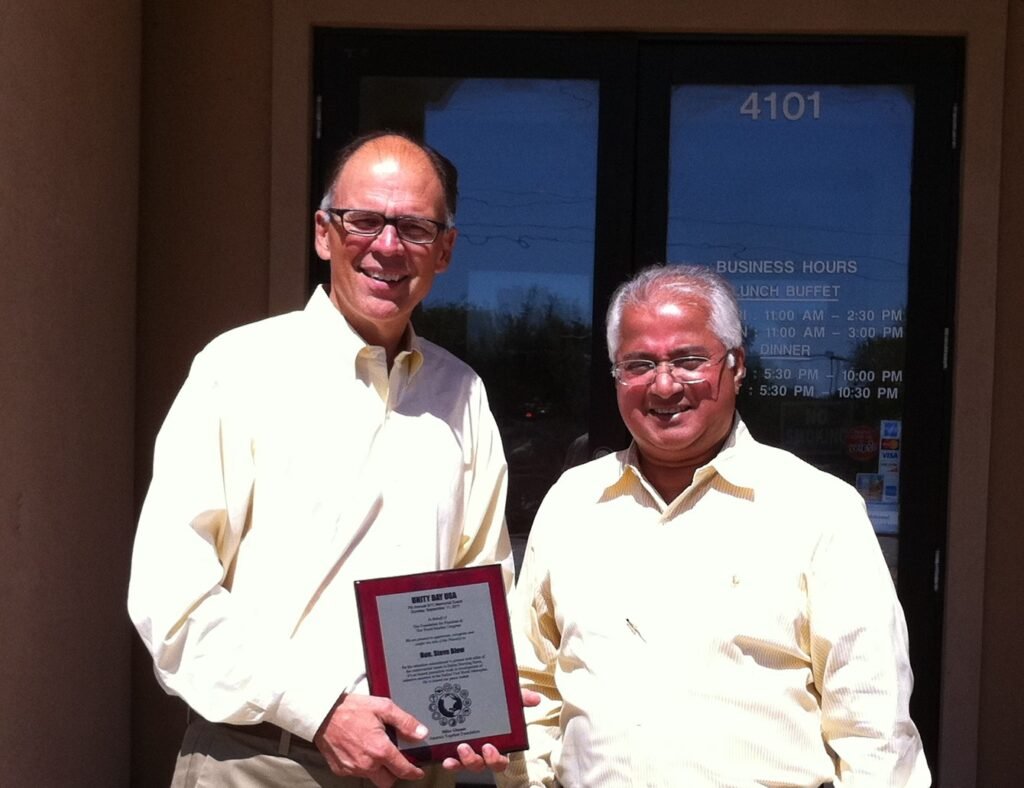
Steve Blow wrote this piece in the Dallas Morning News
Over and over, you hear it said: If Muslims oppose terrorism, why don’t they stand up and say it?
If that has been you, Mike Ghouse ought to be your hero.
It is hard to imagine that anyone has worked harder than the Carrollton resident to demonstrate the peaceful and moderate side of Islam.
And that effort includes personally visiting Dallas’ First Baptist Church last Sunday just to put a friendly face on the “evil, evil religion” that the Rev. Robert Jeffress denounced a few weeks before.
Full Article: In defense of Islam, Pursuing A Civil Dialogue
Contact Us
- SpeakerMikeGhouse@gmail.com
- (202) 717-2892
- Query