

A Love Story That Proves Great Relationships Aren't Built on Perfect Similarities—They're Built on Great Conversations
Not Every Love Story Begins With Fireworks
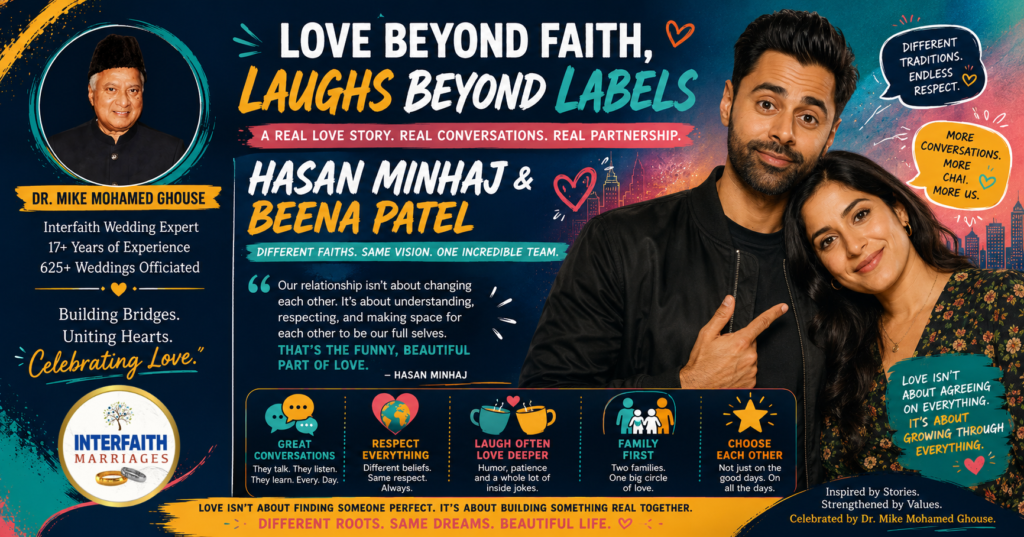
Some begin with a movie scene.
Some begin with love at first sight.
And some begin with… awkward conversations, questionable jokes, and two people slowly realizing they’ve found someone who simply gets them.
That feels much closer to the story of Hasan Minhaj and Beena Patel.
Their relationship isn’t famous because of dramatic headlines or fairy-tale romance. It’s memorable because it feels wonderfully real. Two ambitious people. Two South Asian families. Different faith traditions. Plenty of conversations. Plenty of learning. And a shared willingness to build a life together without pretending their differences didn’t exist.
For anyone who has ever wondered whether an interfaith relationship can actually be… normal, their story offers a refreshing answer.
Yes.
It absolutely can.
When Reality Is Better Than the Romantic Comedy
Hasan Minhaj has built a career making people laugh while asking difficult questions about identity, family, race, religion, and belonging.
Long before millions watched him on stage or on Netflix, he met Beena Patel, a healthcare professional whose life existed far away from television cameras and comedy specials.
Hasan is Muslim.
Beena is Hindu.
For many people, those two words immediately become the headline.
For Hasan and Beena, they became only one chapter of a much larger story.
Like countless couples around the world, they had to navigate different family traditions, expectations, celebrations, and perspectives.
But instead of allowing those differences to become walls, they treated them as conversations worth having.
And sometimes…
Probably conversations worth laughing about.
Keeping Faith Without Losing Each Other
One of the most admirable aspects of their relationship is that neither person’s identity disappears after marriage.
Their story isn’t about one person changing to make the other comfortable.
It’s about creating space where both people feel respected.
Hasan has often spoken about identity with honesty and humor, reminding audiences that life is rarely as simple as the labels people place on us.
That same philosophy quietly appears throughout his marriage.
Different beliefs.
Different traditions.
One shared commitment.
Dr. Mike Mohamed Ghouse has witnessed a similar pattern throughout more than 625 interfaith and intercultural weddings.
Healthy marriages rarely ask,
“Who has to change?”
Instead, they ask,
“How can we understand each other better?”
That single question often changes everything.
Marriage Doesn’t Need to Be Perfect. It Needs to Be Honest.
Perhaps that’s what makes Hasan and Beena’s relationship feel so relatable.
It isn’t presented as flawless.
It feels human.
It reminds us that successful couples still disagree.
They still misunderstand each other sometimes.
They still have difficult conversations.
The difference is that they continue choosing each other after those conversations end.
Humor helps.
Listening helps even more.
What Modern Couples Can Learn From Their Journey
Laugh Together Often
Humor doesn’t solve every problem, but it can make difficult conversations feel a little less difficult.
Curiosity Beats Assumption
Before assuming what your partner believes, ask.
The conversation might surprise you.
Respect Doesn’t Require Agreement
Healthy relationships leave room for different opinions while protecting mutual respect.
Keep Talking
Communication isn’t something couples finish.
It’s something they continue.
Every day.
Your Story Doesn’t Need to Look Like Anyone Else’s
There is no perfect blueprint for an interfaith or intercultural marriage.
The strongest relationships create their own.
A Reflection on Shared Humanity
Hasan Minhaj often reminds audiences that labels may explain where we come from—but they should never limit where we can go.
His marriage with Beena Patel reflects that same idea.
Their story isn’t really about religion.
Or culture.
Or comedy.
It’s about two people choosing curiosity over judgment, conversation over assumption, and partnership over fear.
That message echoes what Dr. Mike Mohamed Ghouse has experienced through hundreds of interfaith marriages.
The happiest couples are rarely the ones with the fewest differences.
They are usually the ones who never stop trying to understand each other.
Key Takeaway
The best conversations don’t always end with two people thinking the same way—they end with two people understanding each other a little better than they did before.
Contact Us
- SpeakerMikeGhouse@gmail.com
- (202) 717-2892
- Query