

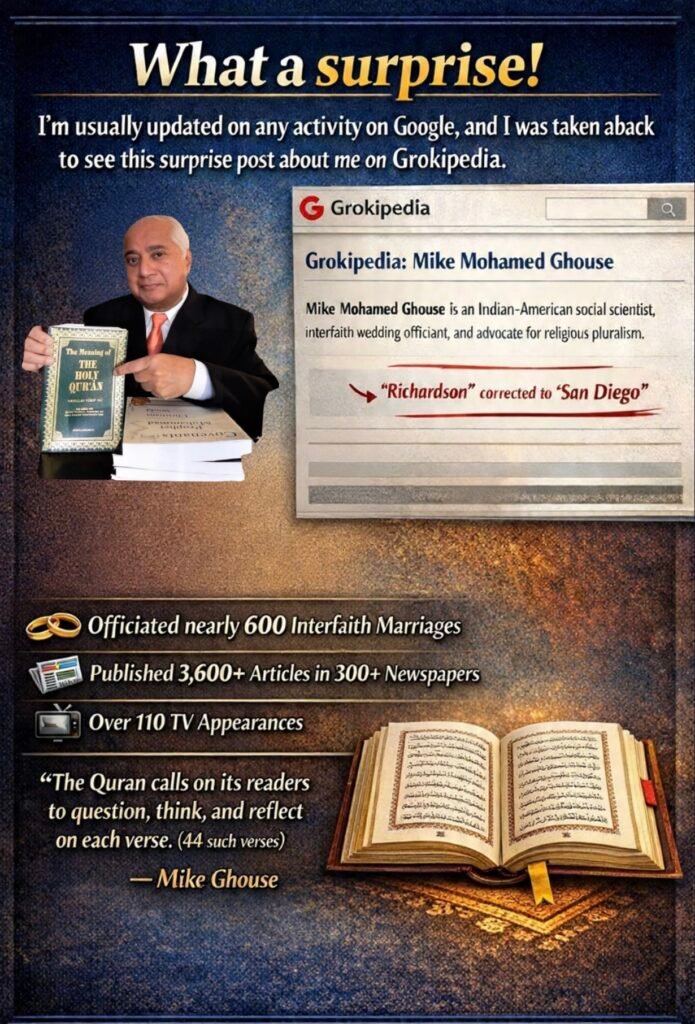
What a surprise! I don’t often receive criticism of my work, writing, speeches, or workshops, or at least I don’t perceive it that way. I tend to view things from a different perspective. I usually keep up with updates about me on Google, so I was taken aback to see a surprising post on Grokipedia criticizing me. Some of the criticism is my take on the translations of the Quran; the Quran encourages its readers to question, think, and reflect on each verse; there are 44 such verses. It does not advocate for blind belief.
Grokipedia: Mike Mohamed Ghouse
https://grokipedia.com/page/mike_mohamed_ghouse
Mike Mohamed Ghouse is an Indian-American social scientist, interfaith wedding officiant, public speaker, and advocate for religious pluralism, best known for officiating nearly 500 interfaith marriages across diverse faiths and ethnicities while promoting societal cohesion through education and dialogue.[1][2]Born and raised in Yelahanka near Bangalore, India, in a multicultural environment shaped by his father’s role as local mayor, Ghouse developed an early commitment to interfaith engagement, later working in Saudi Arabia before immigrating to the United States, where he resided in Dallas and now Washington, D.C.[1] He founded the Center for Pluralism, organizing annual events such as Unity Day USA, Holocaust and Genocides and workshops on multiple religions, alongside authoring over 3,600 articles published in more than 300 newspapers worldwide and appearing on national television, including over 110 segments on Fox News.[1][2]
His book American Muslim Agenda: Building a Cohesive America outlines strategies for integrating Muslims into pluralistic societies, reflecting his efforts to mitigate conflicts arising from diversity.[1]Ghouse’s advocacy for pluralism, including claims that core Islamic texts align with freedoms like those in the U.S. Constitution on apostasy and religious liberty, has drawn criticism from orthodox Muslim perspectives for allegedly misrepresenting Quranic doctrines and Sunnah, such as penalties for leaving Islam outlined in verses like 4:89 and hadiths mandating death for apostates.[3] Critics argue his interpretations prioritize harmony and mercy over literal scriptural commands on warfare, non-Muslims, and punishments, framing them as a “Fantasy Islam” incompatible with traditional exegeses like Tafsir Ibn Kathir.[3] Despite such debates, his work has reached tens of thousands through weddings and events, emphasizing practical coexistence across races, ethnicities, and beliefs.[1]
Early Life and Background
Childhood and Family Origins
Mike Ghouse was born and raised in Yelahanka, a historic town near Bengaluru (formerly Bangalore), India, known for its over 600-year history and as the birthplace of Bengaluru’s founder, Kempe Gowda, in 1537.[4] His family operated a flour mill that served as a community hub, drawing visitors from diverse groups including Adivasis, Gypsies, Hindus, Dalits, Sikhs, Jains, Sikhs Christians, and Muslims, fostering early exposure to pluralism.[4] As a teenager, Ghouse worked alongside his father at the mill, engaging in extended conversations with patrons that emphasized respectful listening across social divides.[4]Ghouse’s father, Mohamed Abdul Rahman, was an Indian freedom fighter who later served as mayor and deputy mayor of Yelahanka in the 1950s, participating in municipal conferences such as the 1952 event in Mandya organized by Chief Minister Kengal Hanumanthiah.[5][6] Rahman instilled values of civic engagement and inter-community harmony, often taking his son to homes of Hindu, Christian, Jain, and Sikh families, where Ghouse sampled varied cuisines and observed inclusive social practices.[4] His mother contributed to this environment through weekly discussions with the town’s sole Zoroastrian resident, while family talks frequently addressed Shia-Sunni theological differences alongside his maternal grandfather.[4]These formative experiences in a multi-religious Indian locale, combined with familial emphasis on dialogue, shaped Ghouse’s foundational views on coexistence, predating his later activism.[5] In his youth, he also joined informal interfaith sessions with mentors like English professor Dr. A. Ramachandra and Muslim weaver Fakhru Bhai, who bridged Hindu and Islamic scholarship in the late 1960s.[4] By college, Ghouse regularly attended services across faiths, including Friday mosque prayers, Saturday Hindu bhajans, Wednesday Buddhist teachings, and monthly church visits.[4]
Immigration and Early Adulthood in the United States
Mike Mohamed Ghouse immigrated to the United States in 1980 after working as Deputy Controller of Finance for Fluor Corporation in Saudi Arabia from 1977 to 1980, managing banking and cash operations across multiple sites including Ras Tanura, Shedgum, Uthmaniya, Jubail, and Dhahran North.[7] His relocation was facilitated by encouragement and sponsorship from his American colleague Everett Blauvelt, whom he met in Saudi Arabia and who had already adopted the nickname “Mike” for him during that period.[7]Upon arrival, Ghouse initially settled in Richardson, Texas, where he was around 25 years old.[7] He continued his education in the U.S., obtaining an MBA from the University of Dallas.[8]During the early 1980s, Ghouse launched his professional career in business management, notably turning around an ailing company to profitability between 1981 and 1983.[9] He subsequently ventured into real estate development and other entrepreneurial activities, including community-oriented projects, which provided the economic base for his later pursuits in civic engagement and activism.[4]
Religious Evolution
Mike Mohamed Ghouse was born into a Muslim family in Yelahanka, India, during the 1950s, where his upbringing involved extensive exposure to diverse religious traditions. His father, the local mayor, facilitated interactions with Hindu, Christian, Jain, Sikh, and Zoroastrian families, while family discussions included Shia-Sunni theology. As a teenager in the late 1960s, Ghouse engaged in interfaith dialogues with mentors, including a Hindu professor and a Muslim weaver, and during college, he attended mosques on Fridays, Hindu temples on Saturdays, Buddhist centers midweek, and churches monthly, though he questioned traditional conceptions of divinity.[4]Following his immigration to the United States and early career abroad, including time in Saudi Arabia in the late 1970s, Ghouse entered a prolonged period of irreligion lasting nearly 30 years, spanning roughly from the 1970s to the late 1990s. During this phase, he identified as an atheist at key moments and distanced himself from organized faith, prioritizing professional and civic engagements amid multicultural work environments involving colleagues from over 40 nationalities.[4][10]In the late 1990s, Ghouse re-embraced Islam, drawing inspiration from the Bhagavad Gita’s wisdom and the writings of religious scholar Karen Armstrong, which prompted a reconnection to his roots while integrating broader interfaith insights. This return marked the foundation of his advocacy for religious pluralism, defined by him as “respecting the otherness of others” without seeking uniformity, leading to his self-identification as a moderate Muslim committed to interfaith harmony, evidenced by subsequent workshops on faiths from atheism to Zoroastrianism and officiation of interfaith ceremonies.[4][11]
Professional Career
Business and Civic Engagements
Ghouse entered the home building industry in 1984 upon joining Gemcraft Homes in Dallas, Texas. The following year, he achieved recognition as the number one manager at Ryland Homes. In 1988, he ranked as the third manager at Grand Homes, demonstrating early success in residential construction management.[12][9] He was recognized as #1 Manager by Drees Homes in 2001. From 1990 to 2000, Ghouse transitioned into management consulting, providing services likely related to his expertise in home building operations and business strategy. During this period, he received accolades from Dallas-area builders for his contributions to the sector, though specific details of consulting projects remain undocumented in public records.[12][9] In parallel with his business pursuits, Ghouse initiated early civic efforts by launching the first South Asian newspaper in Dallas, serving as a platform for community news and cultural integration among immigrants. This venture marked his initial foray into media and community organizing, predating his formalized activism. He later expanded into radio broadcasting, amplifying South Asian voices in the region.[13]
Shift to Social Activism
In the mid-1990s, following a professional background in business management, real estate mortgages, home building, and operational turnarounds, Mike Ghouse transitioned toward social activism centered on pluralism and interfaith dialogue.[9] This shift was marked by his founding of the Foundation for Pluralism in 1996, an organization dedicated to fostering understanding across religious, social, cultural, and political divides through workshops and public initiatives.[14]Concurrently, Ghouse launched a radio program targeting the Desi (South Asian) community in Dallas in 1996, which served as an early platform for discussing community issues and pluralism, evolving into broader civic engagements.[9] By the late 1990s, this activism expanded to include interfaith workshops—conducted over two decades and numbering at least 39 by 2016—and leadership in organizations like the World Muslim Congress, emphasizing conflict mitigation and societal harmony without partisan alignment.[9] His efforts positioned him as a proponent of “respecting the otherness of others,” prioritizing empirical community-building over ideological conformity.[9]
Advocacy for Pluralism
Founding of Organizations
In 1996, Mike Ghouse established the Foundation for Pluralism as a nonprofit organization dedicated to promoting inclusivity and mutual understanding among Americans of varying faiths, ethnicities, and backgrounds, with the goal of creating a society where differences are respected rather than divisive.[15] The entity later rebranded as the Center for Pluralism, under which Ghouse continues to serve as founder and president, emphasizing educational programs, workshops, and advocacy to mitigate conflicts arising from pluralism’s challenges.[16][4]Ghouse also initiated the America Together Foundation, a nonprofit focused on fostering national cohesion by addressing societal divisions through community-building initiatives and public discourse on shared American values.[12][9] This organization reflects his broader commitment to practical pluralism, encouraging participation across political, religious, and cultural lines to reduce alienation and promote collective security.[17]Additionally, in 2001, Ghouse helped establish the World Muslim Congress initially as an online forum (Yahoo group) that evolved into a think tank examining Islamic interpretations compatible with democratic pluralism and interfaith harmony, where he acts as director.[18] These foundations underscore Ghouse’s efforts to institutionalize pluralism as a mechanism for social stability, drawing from his observations of post-9/11 tensions and earlier civic experiences.[19]
Interfaith Initiatives and Marriages
Mike Ghouse has promoted interfaith initiatives through the Center for Pluralism, a non-profit he founded in 1996 to foster cohesive societies by encouraging respect for religious, ethnic, and other differences via workshops, seminars, and advocacy for minority rights.[20] The organization, granted 501(c)(3) status by the IRS on November 17, 2011, has signed over 200 letters to U.S. presidents, the State Department, and foreign governments urging protections for persecuted groups including Baha’is, Buddhists, Christians, Hindus, Jews, Muslims, Sikhs, and atheists.[20] As director of the World Muslim Congress, a think tank advancing pluralism within Islam, Ghouse has organized events and dialogues aimed at mitigating conflicts and nurturing goodwill among diverse faiths.[4]
A central aspect of Ghouse’s interfaith work involves officiating weddings, with nearly 600 interfaith marriages conducted since approximately 2009, spanning combinations of Muslims, Hindus, Christians, Jews, Humanists, Jains, Sikhs, Buddhists, and others across more than 60 ethnicities and four races.[21] Licensed in all 50 U.S. states, he has performed ceremonies in nearly 50 cities from Boston to San Diego, including destination weddings in Mexico, Canada, and the UK, often customizing rituals like Nikah-plus to blend traditions while ensuring family inclusion.[22] He views them as mechanisms to dispel religious misconceptions and promote harmony, as interfaith couples “contribute more to the promotion of peace” by bridging divides.[23]Ghouse’s approach emphasizes pluralism, defined as “respecting the otherness of the others and accepting the God-given uniqueness of each,” which he applies to marriage counseling and ceremonies to mitigate potential conflicts.[23] He offers pre-wedding coaching and has documented specific pairings, such as his 198th Christian-Muslim and 186th Hindu-Muslim weddings, arguing that such unions align with broader societal trends where around 20% of U.S. marriages are interfaith.[24][25] Through these efforts, Ghouse positions interfaith marriages as practical embodiments of pluralism, countering traditionalist restrictions in Islam on cross-faith unions while prioritizing individual choice and familial accord.[22]
Intellectual Contributions
Published Books
Mike Ghouse authored American Muslim Agenda: Muslims Together Building a Cohesive America, published in 2019 by Xlibris.[26] The book serves as a blueprint for American Muslims, emphasizing their role as conflict mitigators and proponents of pluralism to foster societal cohesion rather than confrontation over issues like Islamophobia.[27] Ghouse argues for a paradigm shift, urging Muslims to prioritize integration, civic engagement, and mutual respect across religious lines, drawing on principles of Quranic pluralism and American democratic values.[28]The 358-page volume includes endorsements from interfaith leaders and critiques traditional Muslim isolationism, advocating proactive participation in national dialogues on topics such as patriotism, LGBTQ rights, and Israel-Palestine relations from a pluralistic Islamic perspective.[29] It positions Muslims as contributors to America’s social fabric, with Ghouse presenting himself as a mediator committed to mitigating divisions.[30] As of available records, this remains Ghouse’s sole major published monograph, though he has announced intentions for additional works on pluralism and interfaith themes.[16]
Articles and Public Writings
Ghouse has authored opinion pieces and articles in outlets such as The Huffington Post, where he addresses religious pluralism, Muslim integration in America, and interfaith compatibility with Islamic teachings.[31] His contributions there include a June 30, 2017, piece asserting that Muslims have contributed to the United States since its inception, emphasizing historical participation in national milestones.[31] In another article from December 29, 2017, he examined a fatwa on whether Muslims may celebrate the New Year, advocating for contextual interpretations of religious prohibitions to foster societal harmony.[31]He regularly contributes to the Dallas Morning News‘ Texas Faith panel, offering pluralistic perspectives on topics like self-examination of beliefs and civil dialogue about Islam.[32] For example, in a September 19, 2010, response, Ghouse defended Islam against accusations of inherent deception while calling for open discourse.[33]On independent platforms like Countercurrents.org and Medium, Ghouse publishes essays linking pluralism to current events, such as a July 2, 2021, article portraying July 4th as symbolizing unity among Americans, Indians, and Muslims.[34] His Medium writings include public commentary on political figures and human rights, as in a July 31, 2024, post questioning Kamala Harris’s commitment to religious freedoms.[35] These pieces often reference Quranic verses to argue for Islam’s endorsement of diversity and coexistence, positioning pluralism as a solution to social divisions.[36]Ghouse maintains personal websites featuring reflective essays on identity and faith, such as “My Name is Mike Ghouse,” which details his name choice amid cultural misconceptions about Islam.[37] His public writings consistently prioritize empirical examples from history and scripture to challenge rigid interpretations, though critics contend they diverge from traditionalist exegeses.[3]
Public Presence
Speaking Engagements
Ghouse has organized and spoken at annual events promoting interfaith unity and pluralism, including Unity Day USA, which he initiated in 2005 to foster coexistence among diverse faiths, races, and ethnicities following the September 11, 2001 attacks.[38] The event features pledges of commitment to societal harmony and has been held yearly, with the 10th annual iteration on September 11, 2013, in Mulberry, Florida, drawing dozens to counter a planned Quran burning by Pastor Terry Jones through peaceful dialogue and a 9/11 memorial blood drive.[39][40]He leads Reflections on Holocaust and Genocides, an annual commemoration started in 2006 to acknowledge historical atrocities across faiths and commit to prevention, convening representatives from multiple religions for the first time in its early years.[38] Ghouse also founded annual Thanksgiving Celebrations in 1994, where he speaks on cultural diversity and gratitude, evolving into awards nights recognizing contributions to pluralism.[38]Beyond these, Ghouse has delivered speeches at larger forums, including events with audiences over 5,000, such as rallies and conventions documented in video recordings, and conducted workshops on the essence of religions, including atheism, to promote mutual understanding.[38] He is recognized as a speaker for the Parliament of the World’s Religions, focusing on interfaith themes.[41] In 2016, he moderated and participated in Muslim Speakers Training sessions on October 29 and December 3, aimed at equipping participants for public discourse.[42] A 2022 speech on October 22 addressed topics related to Muslim Congress initiatives.[43]
Media Appearances and Commentary
Ghouse has appeared multiple times on Fox News programs, particularly as a guest on Hannity, where he has debated topics including radical Islam, Sharia law, and U.S. foreign policy toward Muslim-majority countries.[44] On June 20, 2014, during a segment titled “‘Hannity’ Investigation: Radical Muslims on the March,” Ghouse debated host Sean Hannity and other panelists on the growth of Islamist extremism, defending the role of moderate Muslims in countering it while acknowledging internal community challenges.[44] In a May 2013 appearance, he engaged in a heated exchange with Hannity over a Pew Research Center study on global Muslim attitudes toward Sharia and violence, arguing that interpretations of Islamic law vary and that media focus often overlooks pluralistic reforms.[45]Additional Fox News segments featured Ghouse providing commentary on international events. On September 12, 2012, he discussed U.S. responses to attacks on American diplomatic facilities in Libya and Egypt, urging a balanced approach that distinguishes between extremists and the broader Muslim world.[46] In November 2013, amid debates on the Iran nuclear deal, Ghouse addressed Iran’s history of supporting militias that targeted U.S. forces, while advocating for diplomatic engagement rooted in mutual security interests.[47] He also commented on the March 2014 disappearance of Malaysia Airlines Flight 370, highlighting potential terrorism risks without premature conclusions.[48]Beyond television, Ghouse has guested on syndicated radio shows, including appearances alongside Hannity for analysis of events like post-revolutionary developments in Egypt in April 2012.[49] His media commentary consistently promotes religious pluralism, condemns jihadist violence, and critiques both Islamist radicalism and anti-Muslim generalizations, positioning him as a voice for moderate Islamic perspectives in conservative-leaning outlets. Appearances on other networks, such as discussions of American Muslim responses to radicalism in a December 2016 Fox segment, underscore his emphasis on community self-policing against extremism.[50] These engagements have totaled dozens, though verified transcripts confirm recurrent participation from 2006 onward.[51]
Controversies and Criticisms
Challenges from Traditionalist Muslims
Traditionalist Muslims have criticized Mike Ghouse for promoting religious pluralism.[9] In a 2014 article, Ghouse referenced fatwas from Indonesian clerical councils condemning pluralism, secularism, and interfaith prayers as “un-Islamic,” reflecting broader orthodox opposition to his efforts to integrate diverse faiths without prioritizing Islamic supremacy.[52]Critics, including self-identified orthodox Muslims, have accused Ghouse of deviating from Sunni orthodoxy, labeling him a “misguided person” whose beliefs align more with Ismailism—a Shia sect often viewed suspiciously by Sunnis—rather than authentic Islam.[53] For instance, in online forums responding to his writings on sectarianism, commenter Farrukh issued a public warning in 2016: “This is a warning to all Muslims in this forum that Mike Ghouse’s religion is not Islam, he is Ismaili, and he is misguided person.”[53] Such attacks portray Ghouse’s rejection of denominational labels and embrace of interfaith unity as heretical dilutions of Islamic identity. Ghouse’s support for interfaith marriages has drawn particular ire from traditionalists.[9] Islamic scholars cited in critiques argue his “liberal” reinterpretations conform Islam to Western secular norms, prioritizing societal harmony over scriptural fidelity.[9] Despite these challenges, Ghouse maintains his positions stem from Quranic principles of justice and coexistence, though traditionalists dismiss this as selective exegesis.
Debates on Islamic Interpretation and Pluralism
Ghouse advocates an interpretive framework of Islam that emphasizes pluralism, drawing on Quranic verses such as 49:13 (“O mankind, indeed We have created you from male and female and made you peoples and tribes that you may know one another”) to argue for mutual recognition and coexistence among religions rather than supremacy.[54] He has organized events like Quran conferences to highlight universal ethical principles in the text, asserting in 2014 that the Quran addresses all humanity, not exclusively Muslims, as God is described as the creator of multiple universes without proprietary claim to one faith.[54] This approach rejects exclusivist readings prevalent in some traditional tafsirs, positioning pluralism as inherent to prophetic missions, including Muhammad’s, to foster societal cohesion in diverse settings like the United States.[52]Traditionalist critics, often from Sunni orthodox circles, contend that Ghouse’s interpretations represent a “Fantasy Islam” that dilutes core doctrines by misrepresenting Quranic texts and Sunnah on issues like apostasy and religious liberty.[3] In a 2017 New Age Islam discussion, commenter Farrukh warned readers that “Mike Ghouse’s religion is not Islam, he is Ismaili, and he is misguided,” reflecting accusations of sectarian deviation and bid’ah (innovation) in promoting interfaith equality over fiqh-based hierarchies.[53] Such critiques align with broader fatwas, including those from 2014 assemblies in Indonesia and Pakistan, which deemed pluralism, alongside secularism, “un-Islamic” for undermining tawhid and sharia primacy, implicitly targeting reformers like Ghouse who adapt teachings to pluralistic democracies.[52]Ghouse counters by invoking historical precedents, such as the Prophet Muhammad’s Constitution of Medina, which institutionalized pluralism among Muslims, Jews, and pagans in 622 CE, arguing that rigid literalism ignores contextual abrogation and maqasid (objectives) of sharia like preserving life and community.[55] Detractors, however, view this as selective eisegesis, prioritizing American civic values over classical sources like Ibn Kathir’s tafsir, which emphasize Islam’s abrogating role over prior revelations.[9] These tensions surfaced in interfaith forums where Ghouse defended Muslim participation in non-Islamic rituals, prompting orthodox rebuttals that such acts border on shirk, as seen in criticisms of his interfaith marriage officiations challenging traditional prohibitions under Quran 2:221 and 60:10.[56]The debate underscores a divide between interpretive schools: Ghouse’s progressive pluralism, rooted in empirical observation of multicultural functionality, versus traditionalism’s fidelity to ahadith and ijma, which prioritizes doctrinal purity amid perceived Western cultural erosion.[57] While Ghouse cites declining global Muslim-majority tolerance metrics—e.g., Pew data showing 2013 support for sharia enforcement correlating with sectarian strife—as evidence for reform, critics attribute societal issues to deviation from orthodoxy, not its application.[55] No formal fatwas naming Ghouse directly have been documented in major databases, but his views exemplify the ongoing clash between adaptationist and preservationist paradigms in modern Islamic discourse.[9]
Political and Ideological Critiques
Ghouse’s advocacy for political independence and pluralism has drawn ideological criticism from factions favoring rigid religious or partisan conformity. As a self-described political independent since 2014, he has expressed support for candidates prioritizing “America first” regardless of party affiliation, critiquing both Democratic warmongering under President Biden and Republican figures while praising select Trump executive orders on issues like border security.[58][59][11] In foreign policy contexts, Ghouse’s pluralistic positions have elicited pushback from Islamist sympathizers. In July 2020, he publicly urged Turkish President Recep Tayyip Erdogan to maintain Hagia Sophia as a museum rather than reconvert it to a mosque, citing the Prophet Muhammad’s sunnah of inclusivity and the site’s historical role in fostering interfaith harmony.[60][61] This recommendation, rooted in his commitment to global pluralism over symbolic religious assertions, contrasted with widespread Muslim nationalist celebrations of the reconversion and implicitly challenged narratives of Islamic triumphalism in politics.[61]Domestically, Ghouse has faced ideological skepticism from anti-Islam critics who question his motives in bridging divides, alleging alignment with doctrines like taqiyya (permissible deception in Islam) despite his public defenses of civil dialogue on topics such as Sharia reform and Muslim integration.[33] During the 2015-2016 U.S. election cycle, amid rhetoric from candidates like Donald Trump and Ben Carson on Muslim immigration, Ghouse offered firsthand education on Islam to politicians, a move dismissed by some as naive or strategically disingenuous in advancing pluralistic policies over security concerns.[62][33] These critiques highlight tensions between his first-principles emphasis on empirical coexistence and ideological preferences for exclusionary frameworks.
References
- https://www.theindianpanorama.news/profile/dr-mike-mohamed-ghouse-mr-pluralist-of-america/
- https://interfaithmarriages.org/about-mike-ghouse/
- https://islamseries.org/wp-content/uploads/2015/09/the-fantasy-islam-of-mike-mohamed-ghouse.pdf
- https://interfaithmarriages.org/dr-mike-mohamed-ghouse-mr-pluralist-of-america/
- https://www.huffpost.com/entry/pluralist-father_b_879528
- https://interfaithmarriages.org/muslim-background-of-dr-mike-mohamed-ghouse/
- http://theghousediary.blogspot.com/2010/01/my-name-is-mike-ghouse.html
- https://www.facebook.com/Dr.MikeGhouse/
- https://medium.com/worldmuslimpedia/mike-mohamed-ghouse-a-pluralist-and-an-outstanding-interfaith-and-peace-activist-5db250a38f06
- https://interfaithmarriages.org/no-religion-is-superior-a-transformative-journey-toward-pluralism/
- https://www.newageislam.com/islamic-personalities/new-age-islam-edit-bureau/dr-mike-mohamed-ghouse-dedicated-islam-the-other/d/104858
- https://centerforpluralism.academia.edu/MikeGhouse/CurriculumVitae
- https://www.linkedin.com/pulse/lamp-connects-hearts-dr-mike-muhammad-ghouse-radiant-journey-ghouse–4pyhc
- https://centerforpluralism.com/board-of-directors-new/
- https://themuslimtimes.info/2018/07/12/dr-mike-ghouse-one-of-the-best-muslim-voices-for-pluralism-joins-muslim-times-team/
- https://muslimweddingofficiant.org/about-us/
- https://centerforpluralism.com/pluralism-speaker-mike-ghouse/
- https://worldmuslimcongress.org/
- https://www.linkedin.com/in/mikeghouse
- https://centerforpluralism.com/
- https://interfaithmarriages.org/a-global-interfaith-wedding-officiant-with-nearly-600-ceremonies-across-faiths/
- https://interfaithmarriages.org/
- https://www.newageislam.com/interfaith-dialogue/new-age-islam-staff-writer/promoting-interfaith-harmony-marriages-mike-ghouse-pluralist-committed-promoting-interfaith-marriages/d/126609
- https://www.pewresearch.org/short-reads/2015/06/02/interfaith-marriage/
- https://www.facebook.com/MikeGhouse2/
- https://www.amazon.com/American-Muslim-Agenda-TOGETHER-BUILDING/dp/1984575813
- https://www.barnesandnoble.com/w/american-muslim-agenda-dr-mike-ghouse/1130200810
- https://www.amazon.com/American-Muslim-Agenda-TOGETHER-BUILDING/dp/1984575821
- https://bookshop.org/p/books/american-muslim-agenda-muslims-together-building-a-cohesive-america-dr-mike-ghouse/49d6b0733d12aa55
- https://www.abebooks.com/9781984575821/American-Muslim-Agenda-Muslims-Together-1984575821/plp
- https://www.huffpost.com/author/mikeghouse-302
- https://www.dallasnews.com/opinion/2015/03/31/texas-faith-hmm-do-i-really-believe-that/
- https://www.dallasnews.com/news/2010/09/19/in-defense-of-islam-pursuing-a-civil-dialogue/
- https://countercurrents.org/author/dr-mike-ghouse/
- https://medium.com/@mikeghouse
- https://www.newageislam.com/islam-pluralism/mike-ghouse/this-pope-i-am-muslim/d/24443
- https://muslimweddingofficiant.org/most-read-articles/my-name-is-mike-ghouse/
- https://www.theghousediary.com/
- https://www.huffpost.com/entry/mike-ghouse-unity-day-usa-muslims-quran-burning_n_3896420
- https://www.theledger.com/story/news/2013/09/11/dozens-come-together-for-unity/8146409007/
- https://parliamentofreligions.org/speakers/mike-ghouse/
- https://www.americanmusliminstitution.org/press-releases/muslim-speakers-training-1-of-3/
- https://www.youtube.com/watch?v=lI5fPz9UwA4
- https://www.foxnews.com/transcript/hannity-investigation-radical-muslims-on-the-march
- https://www.huffpost.com/entry/a-few-talking-points-about-sharia-after-losing-a-sean-hannity-shouting-match_b_3200730
- https://www.foxnews.com/transcript/how-should-us-respond-to-attacks-in-libya-egypt
- https://www.foxnews.com/transcript/iran-nuclear-deal-shows-americas-weakness-on-world-stage
- https://www.foxnews.com/transcript/missing-malaysian-airlines-flight-was-it-terrorism
- https://kgab.com/monday-on-sean-horowitz-ghouse-and-malkin/
- https://www.foxnews.com/video/5263222134001
- https://www.foxnews.com/story/texas-town-passes-tough-measures-on-illegal-immigration
- https://www.newageislam.com/interfaith-dialogue/mike-ghouse/is-aakhira-source-muslim-problem/d/98104
- https://www.newageislam.com/islam-sectarianism/dr-mike-ghouse/sunni-muslim-that-i-am/d/106865
- https://www.huffpost.com/entry/quran-is-not-for-muslims_b_6174940
- https://www.huffpost.com/entry/two-islams-the-mangledup-_b_5748280
- https://www.researchgate.net/publication/354209943_Can_a_Muslim_Woman_Marry_a_Non-Muslim_Man
- https://www.newageislam.com/islam-west/dr-mike-ghouse/martin-luther-kings-advice-american-muslims/d/109693
- https://twitter.com/MikeGhouse/status/1748366484487700813
- https://www.linkedin.com/posts/mikeghouse_president-trump-i-watched-the-inauguration-activity-7287533853559128064-2VXt
- https://sabrangindia.in/article/turkey-hagia-sophia-should-not-be-converted-mosque/
- https://islamiclaw.blog/2020/07/28/islamic-law-in-plain-english-2/