
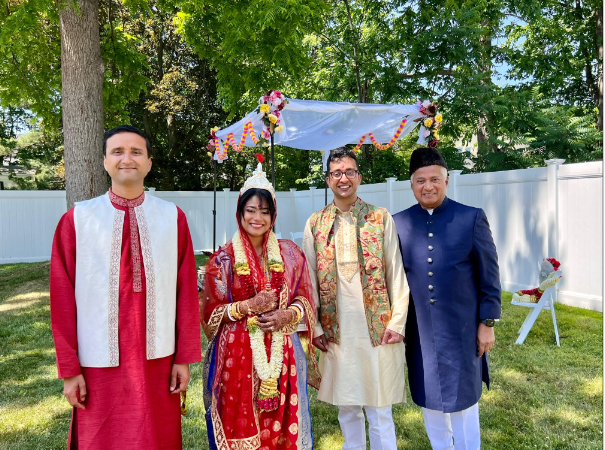
As of December 31, 2025, I have officiated a total of 598 weddings, of which 186 were Hindu-Muslim weddings.
A Hindu-Muslim interfaith wedding is more than just a ceremony; it serves as a sacred bridge between two spiritual traditions. As an interfaith officiant, a pluralist, and a practicing Muslim, I, Dr. Mike Ghouse, have had the honor of solemnizing many such marriages. Each experience reinforces my belief that, at its core, faith embodies compassion, accountability, and devotion to the One Creator.
In every Hindu-Muslim interfaith wedding I officiate, I honor both traditions respectfully, thoughtfully, and with full spiritual integrity. The ceremony becomes not a compromise but a celebration of unity.
Let me guide you through some common processes; however, each wedding is customized to reflect the couple’s religious beliefs, cultural backgrounds, and family customs. I invite you to see how the ceremony unfolds.
Opening the Ceremony: Recitation of Surah Al-Fatiha
After welcoming the guests with inclusive greetings, I give a brief one minute summary for clarity. Every Hindu-Muslim interfaith wedding I conduct begins with the recitation of Surah Al-Fatiha, followed by its English translation. Surah Al-Fatiha is the opening chapter of the Qur’an and invokes the mercy, guidance, and compassion of the Creator of the universe.
I explain to the gathering that we begin with gratitude and acknowledge that there is one Creator who sustains, maintains, and nurtures all life. While traditions may differ in their expressions, the essence of devotion remains the same—humility before the Divine.
If the couple wishes to incorporate a Hindu tradition, I also recite the Gayathri Mantra in Sanskrit, accompanied by its English translation. Both Surah Al-Fatiha and the Gayathri Mantra are universal in nature, setting a tone of mutual respect for the ceremony.
The Mini-Workshop: “What Is My Loss?”
Before proceeding with the rituals and with the permission of the bride and groom, I will introduce what I call my 7-minute mini-workshop on removing biases and promoting peaceful living.
I ask that we keep two questions on our mind:
“What is my loss?” and “What is the essence?”
If someone worships God differently, what is your loss?
If a bride chooses to wear a white dress or a sari, what is your loss
If a groom chants a mantra or says “Bismillah,” what is your loss
If a Sikh wears a turban, what is your loss?
If a Muslim wears a cap, what is your loss?
If a Jew wears a kippa, what is your loss?
If a Saudi wears a long dress from head to toe, what is your loss?
If someone eats with their fingers, what is your loss?
If someone prefers their steak well-done or raw, what is your loss?
Whenever you feel tense or biased toward others’ practices, you can find relief by reflecting on questions like these and countless others.
No matter what food one eats, no food is inferior or superior; the essence of the food is nutrition, so that you can walk and be active. When you accept that, you will be free and will love your life.
Similarly, find the essence of every question, and you will be relieved of bias and enjoy life.
This simple reflection reduces resistance and invites understanding. In a Hindu-Muslim interfaith wedding, families often arrive with hesitation. But when we ask this powerful question, walls soften. Respect begins to grow. The feedback from the guests has been great; they start to see the essence of the rituals and walk away with the feeling that our kids live their lives with the given values. Faith should never threaten us. It should refine us
Shared Spiritual Values Between Hinduism and Islam
One of the most beautiful aspects of a Hindu-Muslim interfaith wedding is discovering shared values.
Belief in One Ultimate Reality
Islam emphasizes faith in one Creator, while Hinduism acknowledges Brahman as the ultimate reality behind creation. Despite differing theological frameworks, both traditions affirm a supreme source of existence.
Accountability and Moral Responsibility
In Islam, individuals are held accountable for their actions on the Day of Judgment. In Hinduism, karma represents the moral law of cause and effect. Both traditions emphasize that actions have significance, and the ultimate goal is freedom.
Spiritual Liberation and Divine Judgment
Islam speaks of the Day of Judgment, while Hinduism discusses moksha, the liberation from the cycle of rebirth. Both religions encourage righteous living and spiritual awareness. For a Muslim, paradise is envisioned as a blissful place, free from concerns about losing a job, health, children, or other life issues. Similarly, moksha in Hindu tradition represents the ultimate achievement—a state of mind free of all tension.
Compassion and Service
Caring for our fellow human beings is central to both traditions. Service, kindness, and charity are considered sacred duties.When families hear this, they often recognize something profound: the foundations of these traditions are quite similar, and their children—the bride and groom—are likely to have a life filled with tranquility and harmony.
The Hindu Ceremony: Sacred Rituals Led by the Pandit
In a Hindu-Muslim interfaith wedding, the Hindu portion of the ceremony is conducted by the Pandit. Each ritual holds profound symbolism. However, if the couple prefers, I can officiate a Hindu light ceremony alongside the Nikah. Nikah signifies the union of two souls, two individuals, as described in the Quran.
Kanyadaan
The bride’s parents symbolically offer their daughter in marriage, entrusting her well-being to the groom. This act represents love, trust, and sacred responsibility. However, some Hindu brides resist this practice, viewing it as misogynistic. We honor both their wishes; after all, it is a customized wedding for the specific couple.
Havan (Sacred Fire Ritual)
A sacred fire is lit, representing divine presence. Offerings are made into the fire, symbolizing purity and commitment.
Saat Phere (Seven Sacred Circles)
The couple walks around the sacred fire seven times, with each circle representing a universal vow: nourishment, strength, prosperity, family, harmony, friendship, and lifelong companionship.
The Saat Phere forms the spiritual foundation of a Hindu wedding, where each step symbolizes a promise of shared responsibility.
Sindoor and Mangalsutra
The groom applies Sindoor (vermilion) on the bride’s forehead and ties the mangalsutra (sacred necklace of black beads symbolizing marital commitment). Throughout these rituals, I stand in support, ensuring dignity and reverence for each tradition.
The Islamic Nikah: Consent, Commitment, and Qabool Hai
After the Hindu rituals, we proceed to the Islamic component of the Hindu-Muslim interfaith wedding.
Khutbah (Marriage Sermon)
Towards the end, I deliver a brief sermon on marriage in Islam, emphasizing mercy, partnership, and mutual respect. Marriage in Islam is a contract rooted in compassion.
Mehr (Dower)
The groom presents the Mehr (security) to the bride, symbolizing her right to financial security and respect. Islam greatly emphasizes the dignity and security of women.
Consent and Qabool Hai or just Qabool
The most essential element in Islam is consent. I ask the bride and groom separately:
“Do you accept this marriage?”
They respond, “Qabool Hai” (I accept), three times.
In interfaith weddings involving Christian-Muslim couples, vows like “I do” may precede the Islamic affirmation. But in a Hindu-Muslim interfaith wedding, the Qabool Hai finalizes the Islamic contract.
Consent is the heart of Nikah.
Integration Without Dilution
One important principle I uphold is this: integration does not mean dilution.
In a Hindu-Muslim interfaith wedding, the majority of the structure may be facilitated by me as the officiant. However:
● Hindu rituals are led by the Pandit if the couple prefers.
● Islamic elements are led by me.
● Each tradition remains authentic.
● No ritual contradicts the core belief of either faith.
This approach builds trust.
Essence of Islam in Interfaith Marriage
Islam emphasizes justice, equality, compassion, and accountability. The Qur’an describes marriage as a relationship characterized by tranquility, love, and mercy.
As a Muslim, I prioritize the core principles of Islam, which include mutual consent, clarity in contracts, and moral responsibility.
However, as an interfaith officiant, I also respect and honor the dignity of other faith traditions. True faith is never insecure.
Why a Hindu-Muslim Interfaith Wedding Works
When conducted respectfully, a Hindu-Muslim interfaith wedding works because:
● It honors both families.
● It emphasizes shared moral values.
● It avoids forcing conversion.
● It promotes social harmony.
● It teaches children pluralism
Marriage becomes a model of coexistence.
Frequently Asked Questions (FAQs)
1. Is a Hindu-Muslim interfaith wedding religiously valid?
Yes, when conducted with proper consent and clear understanding of both traditions, it fulfills ceremonial and spiritual requirements.
2. Do both partners need to convert?
There is no requirement for conversion. Islam insists on no compulsion in matters of faith.
3. What comes first, Hindu rituals or Nikah?
It depends on the couple’s choice. We have done one after the other with a lunch break and also done jointly by the Hindu Pandit and I.
4. Is Mehr required?
Yes, Mehr is an essential part of the Islamic Nikah, it is financial security for the woman to live a dignified life in case the husband does not return home from a conflict.
5. Can families participate equally?
Absolutely. Inclusion strengthens the ceremony. As professional wedding officiant, I speak with both the families to be on the same page. I have spoken with more than 700 families,
6. What makes this different from a civil marriage?
A Hindu-Muslim interfaith wedding integrates sacred rituals and spiritual commitments beyond legal formalities. We do integrate all the three marriages in one. You always have many options to select from.
Conclusion: A Marriage of Respect, Not Compromise
A Hindu-Muslim interfaith wedding is not about blending faiths into confusion. It is about standing firmly in one’s belief while honoring another’s devotion.
I see these weddings as living examples of pluralism. They prove that love does not erase identity—it enriches it.
When we ask, “What is your loss?” We discover something profound: respect costs nothing, but it builds everything.
And that is the true blessing of a Hindu-Muslim interfaith wedding.
Latest articles about Mike Ghouse
A Lamp That Connects Hearts: Dr. Mike Mohamed Ghouse — A Radiant Journey of Love, Thought, and Service
https://thejagotimes.com/a-lamp-that-connects-hearts-dr-mike-muhammad-ghouse-a-radiant-journey-of-love-thought-and-service/
Mr. Pluralist of America Panorama https://www.theindianpanorama.news/profile/dr-mike-mohamed-ghouse-mr-pluralist-of-america/
Background of Dr. Mike Mohamed Ghouse
https://interfaithmarriages.org/muslim-background-of-dr-mike-mohamed-ghouse/
Dr. Ghouse is the President and founder of the Center for Pluralism and director of the World Muslim Congress. He is an Interfaith Wedding Officiant for InterfaithMarriages.org and a Muslim Wedding Officiant. He is a Muslim, Pluralist, activist, speaker, author, and social scientist. More on Google